
ASO.dev or ASOmobile: Which to Choose in 2026?
In ASO.dev, we help you move from App Store organic keyword discovery to localization, visuals, and publishing, without paying extra for each app, keyword list, or manual competitor. ASOmobile combines browser research for the App Store and Google Play with modeled market estimates.
By the ASO.dev team. Main comparison verified on September 8, 2026; our programmatic access terms on October 4.
The 30-second answer
Section titled “The 30-second answer”On a narrow screen, scroll tables horizontally to see every column.
| What determines the choice | ASO.dev | ASOmobile |
|---|---|---|
| App Store organic keywords and competitors | One-click organic discovery; Keywords Competitors without collecting pages | App keywords, suggestions, and gaps |
| A broad App Store portfolio | Apps, keyword lists, and manual competitors without per-object limits | Quotas depend on the plan |
| Copy, visuals, and publishing | A connected workflow through store submission | Preparation and export confirmed; direct publishing unconfirmed |
| One specialist, 10 apps | Pro for ongoing work and exports | Pro; check the shared keyword quota |
| A growing monitoring workload | Each seat: apps, keyword lists, and manual competitors without per-object limits | One shared keyword quota; extra logins do not expand it |
| Google Play keywords | Not the product’s main scenario | A strong built-in workflow |
| Download and revenue estimates | No equivalent two-store market estimates | Modeled estimates available |
The main difference
Section titled “The main difference”An ASOmobile plan sets a shared bundle of apps, tracked keywords, competitors, users, review replies, AI, and API credits for programmatic data access. It suits a defined workload; as the portfolio grows, each quota needs attention.
In ASO.dev, our main subscription unit is a person. Apps, keyword lists, and manually added competitors in the core ASO workflow are not billed individually.
Connected store accounts and workspaces belong to the same seat; each active colleague uses their own.
Our plan determines history and available features. Computation and automation keep separate quotas:
- Tasks — the size of individual computations;
- Subscriptions — active rules;
- Share of advertising visibility (SOV) — the monitored keyword-and-country set;
- Developer API — requests and credits.
ASOmobile strengths
Section titled “ASOmobile strengths”- Google Play keywords. ASOmobile researches keywords in both stores through one web interface. We support Google Play Console work, but do not have comparable Android keyword research.
- Market estimates. Modeled downloads and revenue, Store Insights, and featuring data help select countries and categories. The main market-intelligence modules require Maximum; estimates differ from an app’s direct reporting.
- Browser access for colleagues. Free lets you try the interface; Pro gives three users access to all or selected apps. Colleagues can view a specialist’s results while apps and keywords remain within the shared bundle quota.
ASO.dev strengths
Section titled “ASO.dev strengths”- Grow a portfolio without per-object charges. Adding apps, keyword lists, or manual competitors does not raise a specialist’s seat price: the core working set need not be trimmed to fit a bundle quota. Pro suits ongoing work with 10 apps; computation and programmatic access retain separate quotas.
- Discover organic keywords in one click. Tasks collect the competitive set and up to 20,000 keywords, while Keywords Competitors compares your app’s rankings with several competitors. This gives you an App Store opportunity set, not just suggestions for a single keyword; a specialist still checks relevance.
- Work with the full dataset. Discovered keywords open in one desktop table: filters and sorting apply to the entire set, without manually paging through results. Pro exports it in full to Excel/CSV, including more than 20,000 rows when the report contains that many; ASOmobile has not publicly specified the limits of comparable exports.
- Take a hypothesis through to publishing. The bulk editor and App Store Connect connect copy, screenshots, video, and page variants to store submission, rather than just preparing a file. A person reviews translations and media; Xcode, Fastlane, or CI uploads the iOS binary.
- Investigate advertising keywords and visuals. On Marketing, Ads by Keyword shows Ads 1 and Ads 2, advertisers, and actual creatives; you can move from a keyword to a creative and back. SOV retains timestamped check history; bids remain managed in the advertising console.
Price for 10 apps
Section titled “Price for 10 apps”Total cost of ownership (TCO) depends not only on plan price but also on what is constrained. For one specialist managing 10 apps with regular exports, we recommend ASO.dev Pro. ASO.dev Indie suits an independent developer’s first cycle. ASOmobile’s minimum plan for 10 apps is Pro, with 1,500 shared tracked keywords.
Prices below are US dollars before tax, showing monthly payment and the full annual charge separately. API credits fund programmatic requests; the AI quota covers AI operations inside ASOmobile.
ASOmobile plans
Section titled “ASOmobile plans”| ASOmobile plan | Monthly / annual price and public quotas |
|---|---|
| Free | $0: 2 apps; 20 keywords; 1 user; 10 competitors; 100 replies; AI — 0; API — 0 |
| Indie | $59 / $564: 5 apps; 500 keywords; 1 user; 50 competitors; 500 replies; AI — 0; API — 1,000 |
| Pro | $119 / $1,140: 10 apps; 1,500 keywords; 3 users; 150 competitors; 1,000 replies; AI — 100; API — 5,000 |
| Max | $229 / $2,196: 50 apps; 4,000 keywords; 5 users; 300 competitors; 2,000 replies; AI — 300; API — 50,000 |
| Maximum | $299 / $2,868: 100 apps; 6,000 keywords; 5 users; 1,000 competitors; 3,000 replies; AI — 1,000; API — 100,000 |
ASOmobile: plan discrepancies and workload calculation
ASOmobile Max’s 300 competitors and 2,000 replies come from the official help matrix; Pricing swaps the labels. The June 2026 help page lists 20 apps and 15,000 API units for Pro; Pricing lists 10 apps and 5,000. For Indie, help lists 3,000 API units and Pricing lists 1,000.
ASOmobile Custom increases quotas, and API credits can be purchased; public extension prices were not found.
If every app-and-keyword combination counts separately, 10 apps with 50 keywords each create 500 combinations; 200 each create 2,000. Counting five countries separately gives 2,500–10,000. This is a workload illustration; ASOmobile’s billing formula is not publicly described.
Tracked-keyword quotas and research-report sizes are separate parameters. App Keywords and export limits are covered in the automation section.
ASO.dev plans
Section titled “ASO.dev plans”Our ASO.dev Indie plan costs $39 monthly or $348 annually per seat and suits an independent developer’s first cycle. Ranking history is 30 days; exports, CPP, App Clash, and Changelog require higher plans. PPO is available on Indie.
For ongoing work with 10 apps, we budget ASO.dev Pro at $828 per year per person. It costs $89 monthly. ASO.dev Marketing with Apple Ads costs $199 monthly or $1,788 annually.
An ASO.dev team can organize payment in two ways. Each specialist can subscribe through their own account while the team collaborates through shared workspaces. Or one payer can add several seats to a single purchase during checkout.
In both cases, every active specialist keeps an individual account and seat. Both payment options retain the core ASO capacity of each seat.
Team working capacity
Section titled “Team working capacity”| Plan or configuration | Price | Workload planning guide |
|---|---|---|
| ASO.dev Indie, 1 seat | $348/year | A first ASO cycle, not the professional baseline |
| ASO.dev Pro, 1 seat | $828/year | One specialist; apps, keyword lists, and manual competitors without per-object limits |
| ASO.dev Pro, 2 seats | $1,656/year | Two specialists; each gets apps, keyword lists, and manual competitors without per-object limits |
| ASO.dev Pro, 3 seats | $2,484/year | Three specialists, each with the same core ASO capacity |
| ASOmobile Pro | $1,140/year | 1,500 shared keywords: primarily one specialist with limited monitoring |
| ASOmobile Max | $2,196/year | 4,000 shared keywords; five logins do not expand that capacity |
| ASOmobile Maximum | $2,868/year | 6,000 shared keywords: consider for 2–3 active specialists |
Login count is not working capacity. Split ASOmobile Pro equally among three specialists and each has 500 tracked keywords; split ASOmobile Maximum among five and each has 1,200. That is a small allowance for independent portfolios spanning several apps and countries. An extra login helps a colleague view results, but does not add keywords for an active ASO specialist.
ASOmobile Pro for one specialist and ASOmobile Maximum for 2–3 are therefore our planning estimates for regular work, not official ASOmobile limits. Equally divided, ASOmobile Maximum gives 2,000–3,000 keywords per active specialist, but adequacy still depends on apps and geography. This illustrates bundle capacity, not a confirmed keyword accounting formula across countries and devices.
Each ASO.dev seat retains apps, keyword lists, and manual competitors without per-object limits; five ASO.dev Pro seats cost $4,140 annually. Compute and machine-access quotas remain. Use the same working dataset when comparing prices.
ASOmobile can be cost-effective when several colleagues work with one small, fixed dataset or primarily need two-store data and market estimates. For independent broad portfolios, the shared quota becomes the main constraint.
An example workflow
Section titled “An example workflow”Consider a modeled app-page update based on a discovered query.
- Find an opportunity. In ASO.dev, run organic discovery and open Keywords Competitors. In ASOmobile, start with competitor keywords and long-tail suggestions for the required store.
- Test the hypothesis. Compare rankings, history, and reviews. ASO.dev connects App Store keywords with advertising results; ASOmobile adds modeled estimates for market selection.
- Prepare changes. In ASO.dev, prepare localizations and visuals, review the result, and submit it to the store. ASOmobile helps assemble and export copy.
After publishing, compare rankings and reviews with the original snapshot. The capabilities and limits of each stage follow.
Full task-by-task comparison
Section titled “Full task-by-task comparison”Keywords and competitors
Section titled “Keywords and competitors”ASOmobile’s App Keywords, Keyword Finder, Keyword Check, Keyword Suggest, Keyword Select, Spy Keywords, Spy Competitors, and Worldwide Check provide app keywords, suggestions, rankings, and competitor gaps. App Store and Google Play research are connected in the web interface.
For App Store keyword discovery in ASO.dev, Spy and Keyword Explorer provide additional entry points into research.
Competitor Search and Organic Keywords Search start in one click. The second Task collects shared queries from the competitive set over the last seven complete days.
For long-tail queries, our screens show suggestions and let users expand the suggestions for each result. The list can be filtered by word count, and Apple popularity (SAP) history is available beside the current value.
Competitor Search returns up to 50 apps for an owned app on Indie and up to 250 for any app on Pro/Marketing. Organic Keywords Search can return up to 20,000 keywords: automatic mode uses 25 competitors on Indie, while Pro/Marketing advanced modes support 25, 50, or 100 competitors.
ASO.dev Indie works with the selected owned app. On Pro/Marketing, automatic search works with any app; project and mixed modes require an app from the project. Indie’s limit has a discrepancy: the guide lists 5,000 keywords, while the server implementation checked on September 8 allowed up to 20,000. Confirm the current limit before buying; the specialist selects relevant queries in every mode.
Keywords Competitors builds the union of selected competitors’ keywords for a country, date, and ranking ceiling (Top N), overlays your app and every competitor across two dates, and adds SAP, difficulty, suggestions, and advertising signals.
The entire discovered dataset opens in one desktop table, without collecting pages manually. The server returns one complete result; the interface renders only the visible area for speed. Filters, sorting, and Excel/CSV operate on the whole dataset. ASOmobile confirms multi-competitor comparison, gap discovery, and XLS on Max, but does not publish the maximum app count, set logic, or row and file limits.
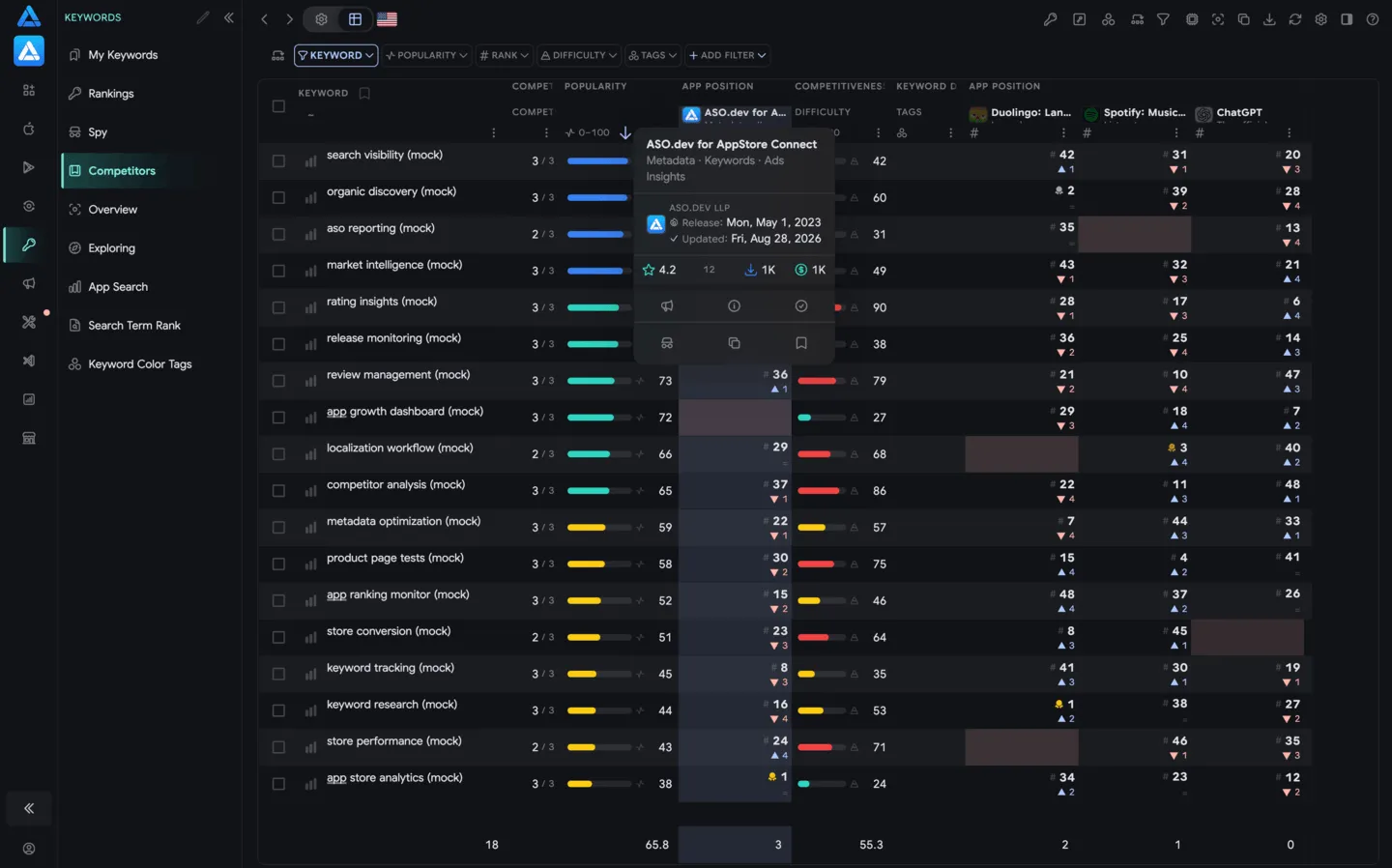
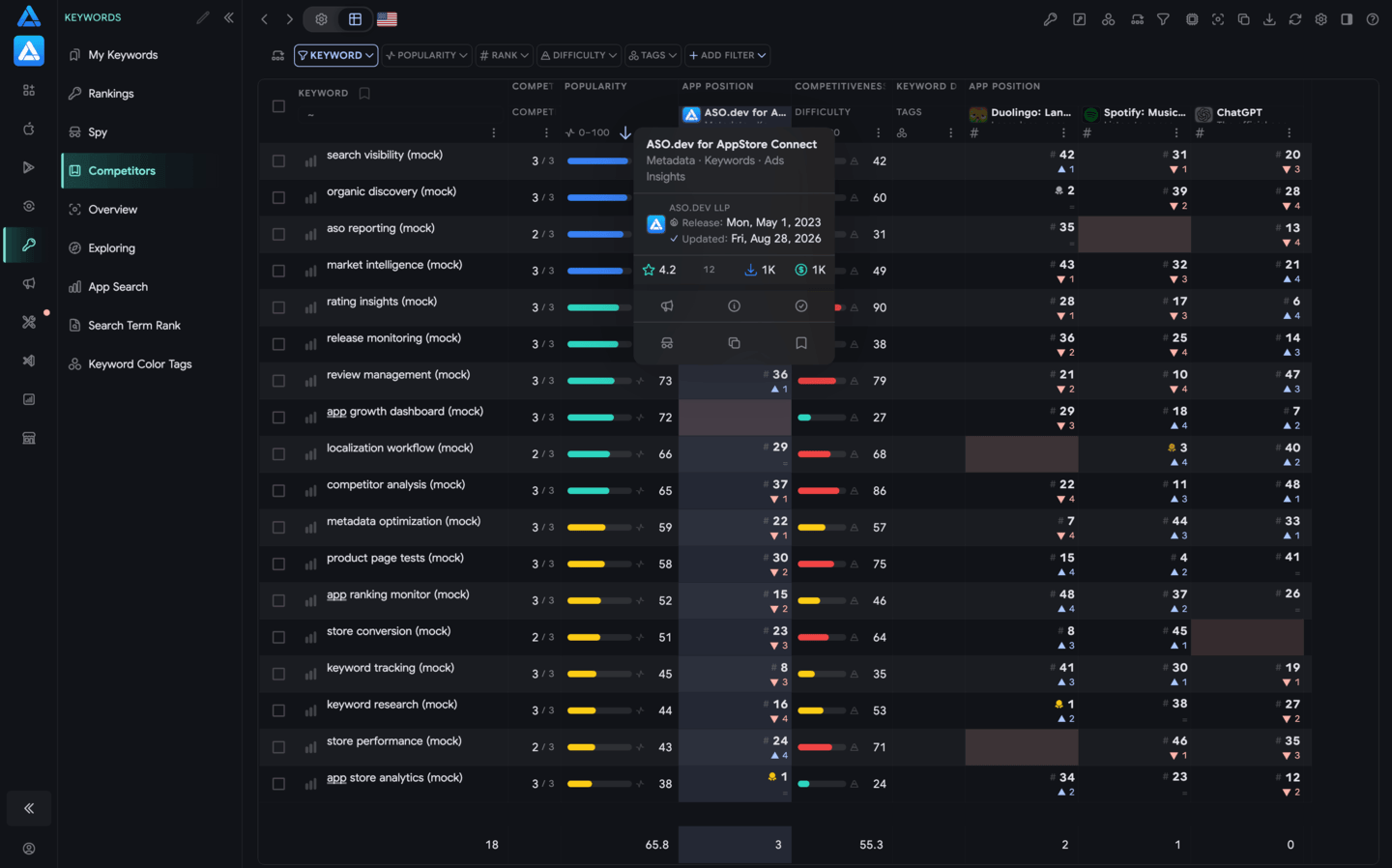
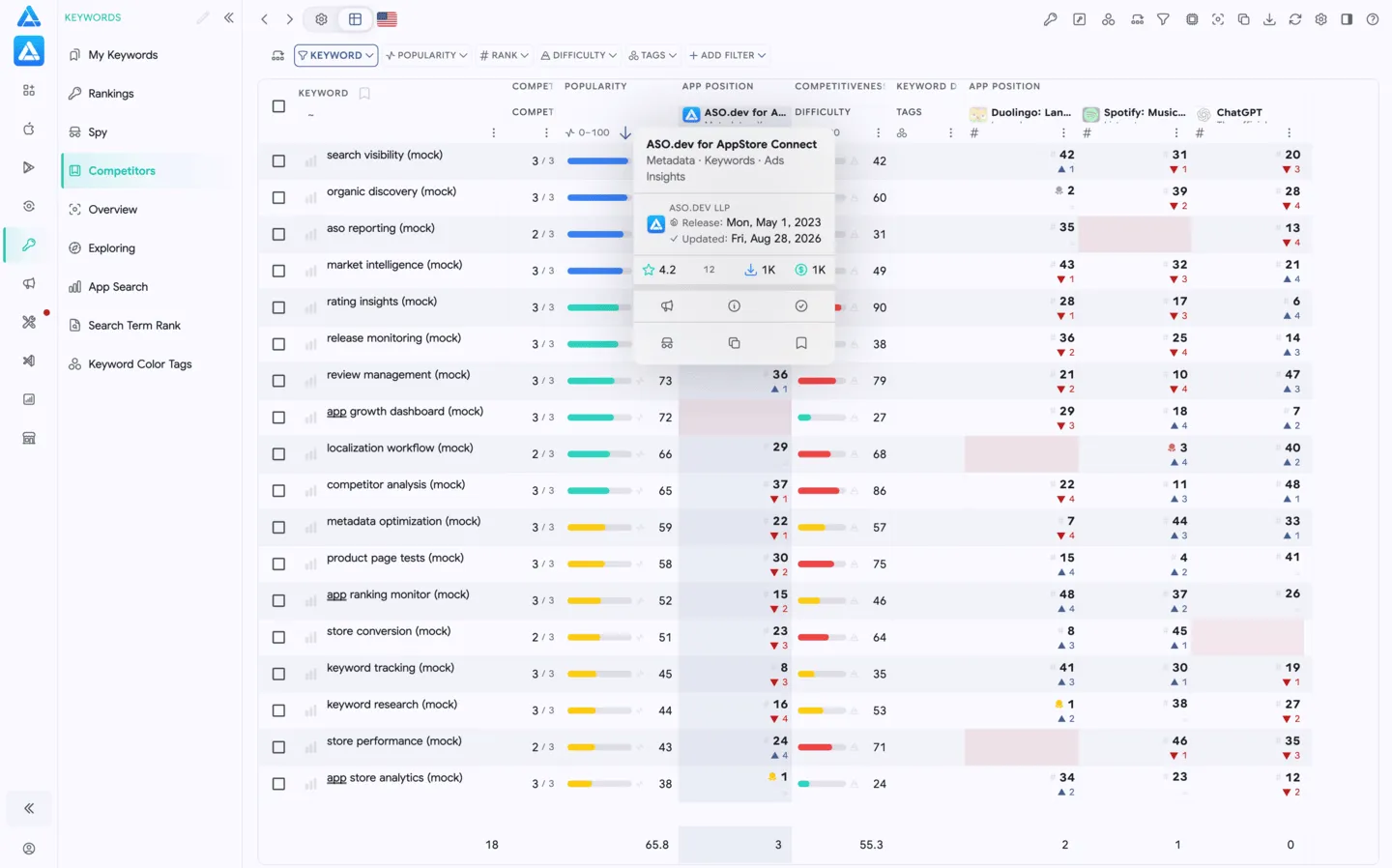
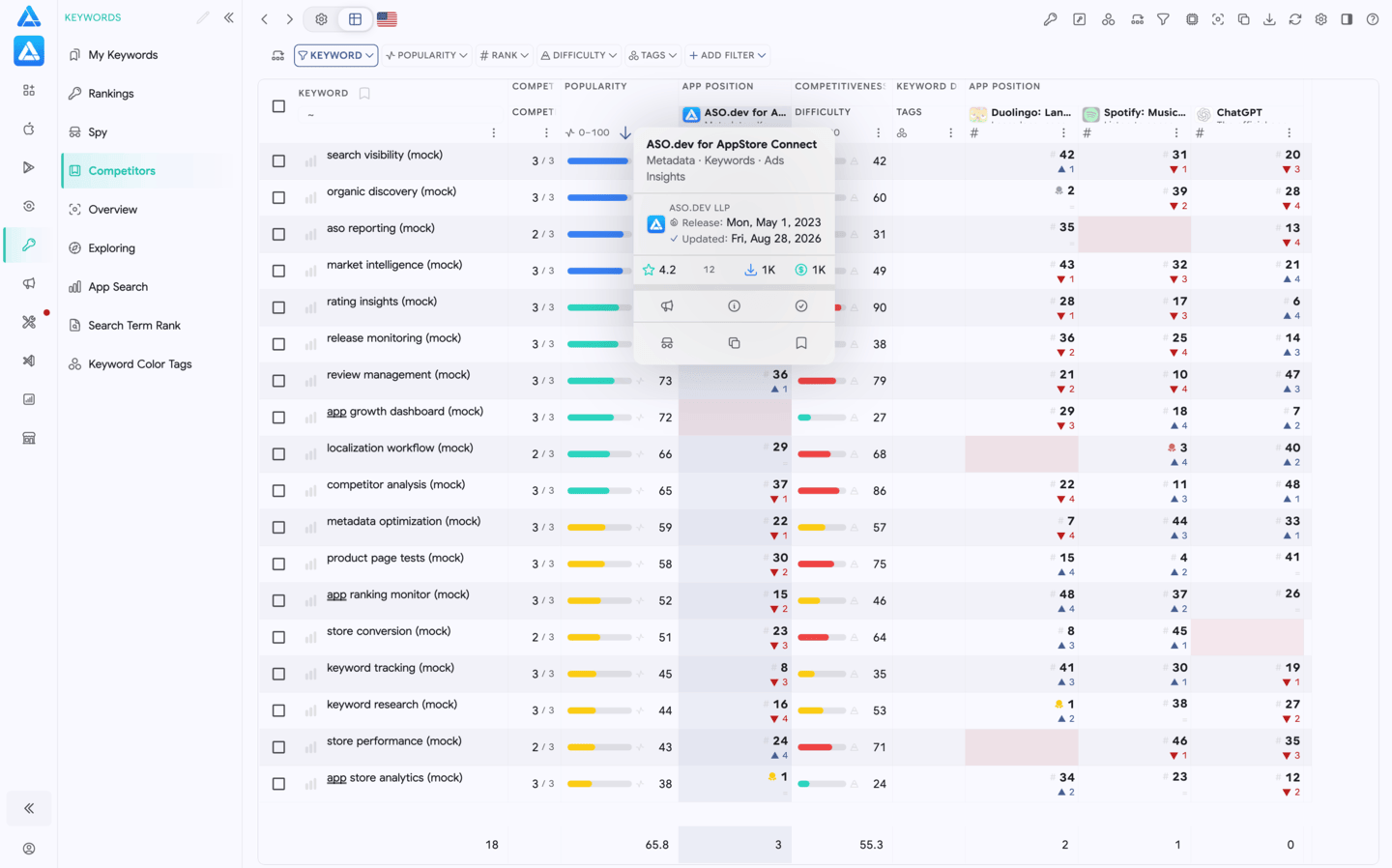
The ASO.dev table shows which keywords rank for the selected apps and where gaps remain. You can filter and export that same dataset without collecting results page by page.
Keyword List checks rankings every four hours and keeps history with the check timestamp. Competitor rankings use a daily snapshot; SAP refreshes separately each day.
ASOmobile says Keyword Monitor updates roughly every six hours in the App Store and twelve hours in Google Play, plus manual refresh. Other pages say four hours or daily tracking, while App Keywords says 48 hours. ASOmobile does not publish a single refresh rate for all its data.
Locales and changes
Section titled “Locales and changes”Both products compare categories, locales, and visual changes. ASOmobile has Top Charts, Similar Apps, Timeline, and Geo Checker. In ASO.dev, Top shows free, paid, top-grossing, and new apps, while Category Ranking shows a snapshot and history.
App Info shows related apps and a reverse recommendation graph.
Changelog records versions, copy, icon, screenshots, and localizations for any App Store app.
App Overview collects localizations and store cards by country, while App Clash compares multiple apps and visual elements. You can check keyword and category rankings, collect locales, and compare competitors’ pages.
A competing app’s Keywords field in App Store Connect is private, so an external service cannot read it directly. The practical substitute is to monitor public copy, organic rankings, and the query set in which an app starts or stops ranking; icons and screenshots can be compared directly.
ASOmobile Timeline separately lists price, category, and size. A specific notification channel for competitor metadata changes is not publicly described. ASO.dev Changelog keeps history; separate push notifications or webhooks for those changes are not publicly documented.
ASOmobile’s real advantage at this stage is one web interface for two stores, Store Insights, featuring data, and modeled download and revenue estimates. The main market-intelligence modules are available on Maximum; proprietary estimates are not direct competitor reporting.
Traffic and Apple data
Section titled “Traffic and Apple data”This uncertainty matters for any model that relies on SAP. From late September to early October 2025, Apple sharply changed Popularity: the number of US queries with SAP above 5 fell by 77.4%, and the API began returning 5 for many keywords. We documented this anomaly in detail.
ASO.dev shows SAP sourced from Apple, its history, and check time instead of turning an indirect signal into a pseudo-precise search count. After the anomaly, the displayed average explicitly excludes new distorted fives while raw values remain in history.
In our internal observations, we refreshed SAP more often and across a broader query pool than the comparable ASOmobile screen. There is no public independent comparison of frequency and coverage.
ASOmobile also responded to the anomaly: its 2025 update overview describes current and previous Search Ads Index values, plus SAP history in Keyword Monitor, App Keywords, Keyword Finder, and Spy Keywords. This helps reveal the signal shift but does not explain how Traffic was recalculated.
Apple Ads and creatives
Section titled “Apple Ads and creatives”ASOmobile Search Ads Spy shows advertised apps by keyword, an app’s advertising keywords, SAP, countries, period, and impression share. We found no public confirmation of Google Ads data, Apple campaign management, Ads 1/Ads 2 classification, or discovery of actual custom product pages and advertising creatives.
On ASO.dev Marketing, Apple Ads shows both ad placements: Ads 1 and Ads 2.
Ads by Keyword shows advertisers, actual creatives, and custom product pages (CPP).
App Ads provides the reverse path from an app to advertising keywords and creatives. A selected asset can return up to 5,000 related queries. This is the result size for an asset; it does not attribute installs.
An active ASO.dev Marketing subscription monitors SOV for 200 keyword-and-country combinations roughly every seven minutes.
A separate dynamic pool with average SAP (AvgPopularity) of at least 60 contained about 45,000 queries during the original August 2026 review; its composition changes. New result batches are published roughly every 20 minutes; a full pass takes longer. SAP itself refreshes daily; the timestamp records our check.
We do not change bids or campaigns. Apple campaign management and Google Ads integration are not publicly confirmed for ASOmobile.
From idea to release
Section titled “From idea to release”ASOmobile’s ASO Generator starts from an app description, discovers keywords, suggests competitors, and creates metadata for both stores. A person reviews the list and copy, then downloads the result or sends it to ASO Creator. This consumes the plan’s separate AI quota.
ASO Creator imports copy, checks length, coverage, and duplicates, creates a draft in a selected language, and exports a file. We found no public confirmation of direct metadata and screenshot submission, bulk media work, releases, built-in A/B tests, custom product pages, or product-page experiments.
In ASO.dev, research continues into practical work. App Overview and App Clash help verify localizations and visual assets.
Metadata Editor extends copy across 50 App Store localizations. The Figma workflow moves it through JSON/ZIP while preserving Auto Layout, Variables, and right-to-left layout (RTL), avoiding a manual rebuild for each language.
Screenshots and video are mapped across localizations and devices. Agent Skills, reusable instructions for AI, help turn media, feature, and review observations into a testable hypothesis list.
The same media workflow applies to the default product page, CPP, and product page optimization experiments (PPO); PPO supports up to three variants.
After checking the result, a person explicitly starts review submission and publishing.
Versions and releases are managed in App Store Connect or Google Play Console.
A person reviews translations and visuals before submission. Xcode, Fastlane, or CI uploads the iOS binary.
Our ASO section includes 19 specialized tools. Other store, advertising, and developer features are covered in the general documentation; availability depends on the plan.
Data for your automation
Section titled “Data for your automation”For custom reports or AI analysis, first choose the access method: a full file, an assistant inside the open app, or scheduled server requests.
Both services provide a server API. For an integration, compare the required data, response size, request frequency, and cost of the same operation. Below, we compare available methods and terms, including the limits of our API’s alpha testing.
| Job | ASO.dev | ASOmobile |
|---|---|---|
| Server integration | Developer API for Pro+: 30,000 test credits on request; alpha | Published REST API; consumes plan quota |
| An assistant using MCP | Local context and actions with user approval | API documentation access publicly confirmed |
| A dataset of 20,000+ rows | Pro+ exports the complete discovered set, including more than 20,000 rows | Not confirmed for App Keywords |
| No manual page collection | Keywords Competitors receives one complete result and works locally | One method has no page parameters; response cap unknown |
MCP is a protocol through which an AI assistant gets context and invokes actions. In ASO.dev, exports suit large analyses and local MCP suits editor work. Both services provide API access for background integrations.
ASOmobile server access
Section titled “ASOmobile server access”A personal Bearer token starts an asynchronous request and retrieves JSON by result ID. App Keywords works with one app and one country; a separate method works with one app and a country list. The schema has no page number, cursor, or next-page link; the maximum response size is unknown.
Several responses can be combined in custom code. Before building a regular integration, confirm size, rate and concurrency limits, polling and per-method cost, and result lifetime: these parameters are not publicly described.
The 2025 update overview says App Keywords indexing capacity increased to 3,500 queries. This number refers to indexing and does not define the size of every API response.
Spy Keywords compares several competitors, finds gaps, and exports XLS, but a multi-app API method, exact set logic, row and file limits, and a 20,000+ row export are not documented. A 20,000+ row export from a single-app analysis is not publicly confirmed.
An older official article mentions 13,000+, but does not explain whether this was a sum across countries or a different metric. This number does not establish a single-app export limit.
App Ranking History separately documents chart positions for the last 30 days. Other history depths in ASOmobile are not publicly specified.
Which MCP ASOmobile provides
Section titled “Which MCP ASOmobile provides”The published configuration starts Apidog MCP with a site identifier and no ASOmobile Bearer token. The assistant reads the OpenAPI specification to help write code; these tools do not request an app’s working data.
Reading the specification should not consume API credits. Working REST calls do; ASOmobile’s built-in AI quota and the external model cost are billed separately.
A marketing page also describes an agent retrieving current data. A public data-MCP endpoint, tool catalog, and authorization scheme were not found. For direct access to working data, the published REST API is available to evaluate.
Large datasets and AI in ASO.dev
Section titled “Large datasets and AI in ASO.dev”Organic Keywords Task is limited to 20,000 rows, while Keyword Overview processes a prepared set of up to 50,000 keywords. This is a processing limit, not a promise to discover that many organic keywords for an app.
Keywords Competitors on Pro exports the discovered union in full, after filtering, or by selection. It can exceed 20,000 rows when enough source data exists; the specialist selects relevant keywords.
To find intersections and gaps, filter by each app’s ranking presence and export the result. Selection works in the combined table. A separate set-operation API is not claimed; App Clash is designed for visual app comparison.
Export a large dataset to Excel/CSV without per-row Developer API credits. Analyze the file in Codex, ChatGPT, Claude, or another model, then return the shortlist to Keyword List. External model costs are separate.
Local MCP gives the assistant context from the selected workspace, a supported editor, and the current or loaded review list. It performs supported actions after user approval and does not consume Developer API credits.
ASO.dev: MCP authorization and context
MCP listens only on a local address and requires X-Client-Secret; writes require approval and confirmApply. The full database and tens of thousands of rows are not passed through MCP: export a file for that analysis.
ASO.dev API costs
Section titled “ASO.dev API costs”For reports collected on a schedule, we offer Developer API. Alpha test applications are open to Pro+ subscribers: after account review, you can request 30,000 test credits and create an access token. Methods cover apps and metadata, reviews, rankings and history, keyword lists, Apple popularity, and category charts.
We reduced credit consumption for key operations. For example, current rankings for 50 keywords across yesterday and today cost 6 instead of 60 credits under our previous tariff — ten times less; an eligible own app costs 3. A latest Apple popularity value costs 6 instead of 30 credits. These compare our tariffs in the same credit unit, not ASOmobile credits.
| Data to retrieve | ASO.dev credit cost |
|---|---|
| Stored app details | 1 per app and country |
| Latest Apple popularity value | 6 per keyword, country, and platform |
| Current keyword rankings: yesterday and today | Up to 6 per block of 250 available keywords; up to 3 for an own app |
| Daily category chart | 4 per 200 returned rows; 500 rows cost 10 |
| Live chart directly from Apple | 6 per non-empty request |
| Current app category rankings | 3 for the first 25 rows; capped at 6 per response |
The Developer API test catalog lists Lite with 30,000 credits: $9 one-time, $7 monthly, or $59 annually. Annual billing provides 30,000 each month, not a single annual balance. Purchases are disabled during alpha: access and test credits are granted on request, while published prices are planning estimates that may change.
An API credit is not an AI model token, and credits from different services are not equivalent without comparing the same operation. ASOmobile includes its API quota in the plan, but method and extension prices are not publicly specified. Define the same data and request frequency before comparing costs.
ASO.dev: history pricing, request limits, and billing
- Current rankings include yesterday and today. Very small responses retain a lower row-based price; each page is billed separately. Explicit keyword lists accept up to 100 terms per request; omit the list and use
limit=0for all stored rows, or paginate. - History uses the available dates D for each app–keyword pair: the lowest of 0.3 × D, 2 + 0.2 × (D − 1), and 12 credits. The total is rounded up after discounts. Requests span up to 60 days; this does not guarantee data for every date.
- The 50% ranking discount applies to own apps in an active project, not manually added competitors. Unknown data is not billed; an observed absence of a ranking is available, billable data.
dry_run=trueestimates cost without fetching data or charging credits. The balance and key’s monthly cap must cover the upper estimate; unused reservations are released after the response.- Default limits are 120 requests per UTC minute and 50,000 per UTC day, with an additional one-request-per-three-seconds limit for estimates. Endpoint and key restrictions may differ.
- Empty data responses cost 0, but do not allow unlimited probing: by default, more than 200 requests in 15 minutes with over 80% empty results trigger a five-minute key block.
- Paid-catalog credit packages last one month; unused credits expire. Check the test grant’s validity separately. Existing balances are not automatically converted into a new 30,000-credit grant.
These examples were checked against the October 4, 2026 test policy. Contracts, quotas, and workload costs are still being tested; there is no public SLA. API credits do not limit file exports from the app and are not consumed by local MCP.
Reviews and replies
Section titled “Reviews and replies”Reviews in ASOmobile
Section titled “Reviews in ASOmobile”ASOmobile collects App Store and Google Play reviews and provides filters, translation, templates, tags, charts, reply history, and XLS. Users can reply after connecting a store account; the monthly limit depends on the plan.
The official App Store instructions ask users to create a separate Customer Support user and enter its email address, password, and 2FA code into ASOmobile; Google Play connects through OAuth. We found no public description of credential storage or encryption.
Review webhooks, Slack/Teams/Zendesk routing, auto-reply rules, and a fully automatic server mode are not publicly described.
Reviews in ASO.dev
Section titled “Reviews in ASO.dev”Our New Reviews Subscription monitors an app, country, and event combination. The result remains in Notifications and reaches the device.
On ASO.dev Pro/Marketing, a webhook sends a summary and a link to the full CSV. Active-rule limits are 2,500 / 6,500 / 13,000 on Indie / Pro / Marketing; treat the public CSV URL as a temporary secret.
A separate Reviews Export Task collects selected App Store countries for sentiment, theme, recurring-problem, and feature-request analysis. This helps turn the review stream into hypotheses.
Reviews interface creates and edits App Store and Google Play replies. Bulk AI replies use the instruction, provider, and model selected by the user; a person starts processing for the selected group.
Our local MCP can draft, submit or edit a reply after confirmation, and report an App Store review. There is no persistent event-driven server reply service.
By default, the App Store Connect key and Google service account stay on the device.
Protected storage restricts local access, and requests go directly to Apple/Google or through the user’s proxy. Optional encrypted synchronization is convenient for a team but expands the security boundary.
When using external AI, the chosen model provider processes the submitted text.
Google Play reviews expose only a recently modified feed of roughly seven days, not a complete historical archive.
When both services make sense
Section titled “When both services make sense”Keep ASOmobile for Google Play research or the modeled estimates you need. Choose the minimum bundle that provides those data: the main Market Intelligence modules require Maximum.
Transfer selected keywords and competitors to ASO.dev by file, API, or manually. Use it for the main working set, hypothesis checks, localization, and store submission. Automatic two-way synchronization of ASOmobile’s proprietary metrics is not available.
First identify which data from the second service changes a decision. Duplicate monitoring increases costs; a necessary Google Play signal can justify a separate bundle.
Frequently asked questions
Section titled “Frequently asked questions”Will a subscription cover 10 apps?
ASO.dev includes apps in the specialist’s seat; regular exports require Pro. ASOmobile Pro holds 10 apps, but its shared keyword quota must fit the geography and working dataset.
What will I lose if I switch from ASOmobile to ASO.dev?
Google Play keyword research and ASOmobile’s proprietary Traffic, CI/KEI, download, and revenue estimates. Before switching, export lists and reports with country, store, device, and timestamp definitions, then run parallel tracking. Proprietary metrics do not transfer one to one.
Is ASO.dev an equivalent or an alternative to ASOmobile?
Both help research keywords, competitors, and reviews. ASO.dev is an alternative for deep App Store work and publishing; ASOmobile can remain a second source for Android keywords and modeled estimates.
Do I need a technical specialist?
In ASO.dev, research, localization, publishing, exports, and review handling are available through the interface. A developer is needed for a custom server integration.
Bottom line
Section titled “Bottom line”ASO.dev suits deep App Store work, from organic discovery and large datasets to page updates, without per-object charges for the core portfolio. ASOmobile suits two-store research in a browser and modeled market estimates. Both make sense when Android data or a market model complements that workflow rather than duplicating it.
If your workflow needs another feature, suggest it or email hello@aso.dev.
Choose a plan for your portfolioMethodology and sources
Section titled “Methodology and sources”ASO.dev Developer API terms were additionally checked on October 4, 2026: the test catalog, credit grants, and the current billing contract. The other research dates above are unchanged.
For ASO.dev, we verified:
- pricing and Tasks;
- Subscriptions and App Store reviews;
- Google Play reviews and security;
- MCP and Developer API;
- the current product implementation.
Before buying ASOmobile, also check coverage for the required tool: official materials state 90+ countries and 10 million apps or 60+ countries and 3 million. Overall geography does not determine coverage for every API method.
ASOmobile comments, assignments, approvals, and a team activity log are not publicly specified. Other unknowns are collected in the relevant sections: Traffic and history, quota accounting, API and large exports, data access through MCP, credential storage and review automation, publishing, and Google Ads.