
ASO.dev vs Asodesk in 2026: Which to Choose?
Both products support keyword research, long-tail discovery, locale comparison, and change history. At ASO.dev, we connect that research with localization, images, and publishing so you can manage the whole portfolio from one working hub. Asodesk’s distinct value lies in modeled keyword-install estimates and server-side review-reply rules.
By the ASO.dev team. Facts and prices checked in August–October 2026.
The 30-second answer
Section titled “The 30-second answer”On narrow screens, tables scroll horizontally.
| What decides the choice | Advantage | Practical meaning |
|---|---|---|
| One specialist, 10 apps | ASO.dev Pro | Research and tracking: $828/year versus about $1,908 for Guru; feature sets differ |
| From an idea to 50 localizations | ASO.dev | Copy, images, experiments, and submission are part of one process |
| Ranking-check frequency | ASO.dev by check schedule | Every 4 hours; Asodesk states at least once every 24 hours |
| Apple advertising research | ASO.dev Marketing | Two ad slots, creatives, custom pages, and histories of query popularity and ad visibility |
| Keyword-install estimates | Asodesk | Organic Report helps prioritize, but provides a model rather than attribution |
| Long-tail queries and page history | Both | ASO.dev has suggestions, guided exploration, and change history; Asodesk has ready-made tabs |
| Review management | Depends | ASO.dev offers controlled actions with locally stored keys; Asodesk is stronger in rules and integrations |
The key difference
Section titled “The key difference”Asodesk organizes research around Keyword Manager and Organic Report, and support around Reviews Board. The differences that affect the choice are keyword-install estimates, ready-made review analytics, automatic reply rules, and a public REST API.
At ASO.dev, 19 specialized ASO tools help you build a keyword set, research competitors, and validate hypotheses. Tasks find competitors and organic keywords in one click. Store editors and operations carry the process forward: from a discovered opportunity to localized copy, images, and a release.
The ASO.dev research suite focuses primarily on the App Store. Connected Google Play accounts support metadata, releases, and reviews, but not a comparable full Android keyword-research suite.
We sell an ASO specialist’s workspace, not a bundle of rows. For one specialist, adding an app, keyword list, manually selected competitor, developer account, or workspace does not increase the subscription price. You widen the sample and test hypotheses rather than trim the research to fit available slots. History depth, automated reports, Subscriptions, ads, and Developer API retain separate quotas.
Where Asodesk is stronger
Section titled “Where Asodesk is stronger”- Modeled demand estimates. Organic Report helps prioritize using Daily Impressions and Estimated Installs—query-level impression and install estimates we do not offer one-for-one. The full report is available in Power; Guru received only All Ranked Keywords. Estimates update every 12 hours and are not actual install attribution.
- Review automation. Asodesk offers templates, Tags Analysis, helpdesk integrations, and automatic submission rules. Auto-Replies, Tags Analysis, and integrations are additional features; Huawei and Samsung require individual activation. ASO.dev has no event-driven server-side reply engine and offers less ready-made reputation analytics.
- A public REST API. Asodesk publishes methods, JSON responses, request costs, and separate credit packages for programmatic work. ASO.dev Developer API is still a closed alpha without an SLA; Asodesk’s public documentation helps teams plan a server-side process in advance. We compare specific methods and credit costs below.
How to read Organic Report estimates
For a competitor, Asodesk’s Organic Report estimates installs from ranked keywords, Daily Impressions, positions, rating, review count, and other signals. This mode does not receive the competitor’s actual App Units.
For your own app, connecting App Store Connect lets Asodesk take your search App Units and distribute them across queries using a model. This is a separate mode, but it is still not actual keyword-level attribution.
A relevant query may be missing from the database; the official FAQ recommends adding it manually. Check known queries before assessing the report. No comparable study establishes the completeness of the two indexes.
Since July 2026, Total Organic History can be viewed for a selected period rather than only ten days.
Where ASO.dev is stronger
Section titled “Where ASO.dev is stronger”- A wider sample without scope add-ons. As you expand keyword research or your portfolio, an ASO.dev plan does not increase for each app, keyword list, or manually selected competitor: you pay for a specialist’s seat. Asodesk’s app and keyword allowances depend on the package. ASO.dev automated reports, history, and API retain their own limits.
- Large exports for research and AI. Spy and Competitor Keywords let you work with 20,000+ rows in one table and export them on Pro/Marketing when the report contains that volume. You do not need to assemble pages manually; Asodesk supports exports, but a comparable large-export limit is not publicly specified.
- From research to release. Once you validate a hypothesis, the App Store editor helps roll out copy and images across 50 supported localizations and take the changes through submission. A Google Play editor is available for Android. The team reviews translations and visuals; publishing requires an explicit action.
- Apple advertising context. Apple Ads Insights shows ads by query and app, both ad slots, creatives, and custom product pages. This layer requires Marketing and does not provide advertising-performance attribution.
- Reply from the same workspace. You can translate, filter, and answer App Store reviews and Google Play reviews in the interface, including an AI batch. The user starts the batch, and store keys stay on their device.
What both products offer
Section titled “What both products offer”- Keyword research and long-tail queries. In ASO.dev, Spy provides an app’s ranked keywords, Keyword Explorer exposes suggestions and guided exploration, and Keyword Overview lets you check the discovered phrases together with their suggestions. Asodesk combines sources in Keyword Manager and highlights Long-Tail in Auto-Suggestions. Compare both approaches using your own keyword list.
- Locales and app comparison. ASO.dev App Overview shows metadata, images, ratings, and keyword distribution across localizations, while ASO Check helps identify gaps; App Clash compares several apps and exports the result. Asodesk Localizations shows countries of presence, public text, ratings, and rating counts, including a competitor mode.
- Visuals and change history. ASO.dev Changelog shows text and images before and after updates, including screenshot overlays, while App Info and App Clash support locale and competitor research. Asodesk Visual Comparison and App Update Timeline offer ready-made views of current pages and a change feed for several apps. The screens are organized differently, but both products address the task.
In ASO.dev, App Clash compares metadata, localizations, and metrics for several apps and exports the result. Ranked-keyword comparison uses the separate Competitor Keywords screen. These are different kinds of comparison and should not be conflated.
Asodesk documents a scheduled App Overview covering metadata, rankings, categories, and reviews: daily, weekly, or monthly through email, Slack, and Telegram. This is a scheduled report, not confirmation of an immediate alert for every change.
If you need a signal as soon as text or screenshots change, check the supported events and plan separately. ASO.dev has change history, but current documentation does not confirm equivalent automatic metadata-change alerts.
Cost for 10 apps
Section titled “Cost for 10 apps”For an owner of ten apps, ASO.dev Indie at $348 per year is the lower-cost option if 30 days of detailed history are enough and exports, CPP, and some professional tools are unnecessary. For a specialist who regularly researches competitors, exports data, and publishes changes, Pro at $828 per year is the realistic starting point.
Ten apps fit Asodesk Guru at about $1,908 per year. But if you need full Organic Report with Estimated Installs, capacity alone is not enough: Power at $4,110 per year is required.
| Portfolio task | ASO.dev | Asodesk | What limits the conclusion |
|---|---|---|---|
| 10 apps × 50 queries = 500 pairs | Indie: $348/year or Pro: $828/year | Guru: about $1,908/year | Guru includes All Ranked Keywords, not full Organic Report |
| 10 apps × 200 queries = 2,000 pairs | Pro: $828/year | Guru: about $1,908/year | The 3,000-keyword allowance fits if a pair counts as one record |
| The same 2,000 queries in five countries | Pro price is unchanged | Guru through Custom, depending on country counting | Separate country records could total 10,000, exceeding Power |
| Additional keyword-install modeling | No direct Estimated Installs equivalent | Power: $4,110/year | An additional feature, not the cost of storing 2,000 keywords |
| Apple Ads for the portfolio | Marketing: $1,788/year | Depends on the required APIs and features | Apple Ads Insights is not included in ASO.dev Pro |
Plans and the full calculation
| ASO.dev plan | Monthly billing | Annual billing | What changes the choice |
|---|---|---|---|
| Console | $19 | $180 | Store operations without full ASO research |
| Indie | $39 | $348 | 30 days of detailed history; no exports or CPP |
| Pro | $89 | $828 | Exports, CPP, App Clash, Changelog, and extended history |
| Marketing | $199 | $1,788 | Pro plus Apple Ads Insights |
| Asodesk plan | Monthly billing | Annual billing | Apps | Keywords | Members | Organic Report |
|---|---|---|---|---|---|---|
| Free | $0 | $0 | 1 | 200 | 1 | Not confirmed |
| Pro | $59 | Not rechecked | 2 | 700 | 2 | Not confirmed |
| Guru | $199 | About $1,908 | 10 | 3,000 | 5 | All Ranked Keywords only |
| Power | $449 | $4,110 | 30 | 5,000 | 10 | Full report, including Estimated Installs |
| Custom | On request | On request | Configurable | Configurable | Configurable | Configurable |
To compare total cost of ownership (TCO), the shared scenario uses one primary user, 10 active apps, up to five countries per app, five competitors per app, regular updates, and review replies. The light version has 500 app-keyword pairs; the full version has 2,000. Counting each country separately could increase the full version to 10,000 records.
Five competitors per app create 50 app-competitor links, or up to 250 if countries count separately. Both interpretations fit Asodesk’s published 1,000-competitor allowance. In this scenario, Organic Report or keyword counting changes the price, not competitor count.
ASO.dev Pro costs $89 with monthly billing or $828 annually. Across ten apps, that is about $6.90 per app per month, not a separate per-app price. A second working specialist needs a second seat. Indie costs $39 monthly or $348 annually; Pro and Marketing offer 60 days of detailed history versus Indie’s 30, although some trends extend further.
Asodesk’s June 2026 plan update replaced Ultimate with Power and gave Guru only part of Organic Report. Guru also publishes an allowance of 1,000 competitors and 100 monthly replies; additional review capabilities may be sold separately.
Asodesk Guru costs $199 with monthly billing; the annual tab shows a $159 monthly equivalent, or about $1,908 per year. Power costs $449 monthly or $4,110 annually, including the published additional $200 discount.
A keyword allowance is not an operation allowance. Asodesk separately consumes Daily Keyword Stats when adding keywords to or exporting them from Keyword Table, searching in Stores Analytics or Search Explorer, and forcing data updates. Power includes 12,000 units. Each keyword in such an operation consumes one unit; the consumed allowance returns after 24 hours.
For example, exporting 2,000 keywords from Keyword Table consumes 2,000 Daily Keyword Stats even if you add no new tracked keywords. This applies to the listed operations, not automatically to every Asodesk report. On ASO.dev Pro/Marketing, exporting an already-loaded ASO table does not consume Developer API credits; automated Tasks and API requests have separate quotas.
Agencies and multiple specialists
Section titled “Agencies and multiple specialists”Logins do not multiply keyword quotas. Asodesk’s app and tracked-keyword limits apply to the package, not to each member. Team comparisons must therefore account for the total workload, not just included users.
For a growing team, keep the same workload per person: a separate portfolio of 10 apps and 200 tracked queries per app. One specialist has 2,000 app-keyword pairs; adding colleagues increases both apps and lists. This is a modeled scenario, not a universal consumption standard for ASO specialists.
| Specialists | Total apps | Total pairs | ASO.dev Pro per year | Asodesk plan by capacity |
|---|---|---|---|---|
| 1 | 10 | 2,000 | $828 | Guru, about $1,908/year |
| 2 | 20 | 4,000 | $1,656 | Power, $4,110/year |
| 5 | 50 | 10,000 | $4,140 | Custom, price unknown |
The table assumes one pair occupies one Asodesk slot. If the same query counts separately in each country, five countries could multiply the records by five; confirm the exact rule before paying. Guru is selected here for capacity alone: even one specialist needs Power for full Organic Report with install estimates.
A shared project is a different calculation. Several analysts, a manager, and support may work with one unchanged selection within 30 apps and 5,000 keywords. Power’s included access is useful in that case, but comparing prices by headcount alone does not show whether the package fits each person’s independent research.
ASO.dev Pro scales by working specialists: $828 annually per person. Apple Ads requires Marketing at $1,788 annually per person. Core tracking volume does not add a charge for each app or keyword; Tasks, Subscriptions, SOV, and API retain separate quotas.
The working process
Section titled “The working process”Consider a hypothetical example: you are developing a habit app. Reviews repeatedly say “setup takes too long,” even though the app already offers ready-made habit sets. You need to decide whether to make quick start more visible in the product and store listing, find related queries, and test new screenshots.
Find the need and the keywords. Start with reviews: are people missing the ready-made sets, or is setup genuinely difficult? In the first case, test how the feature is presented; in the second, improve the product first. New keywords will not fix a difficult first launch.
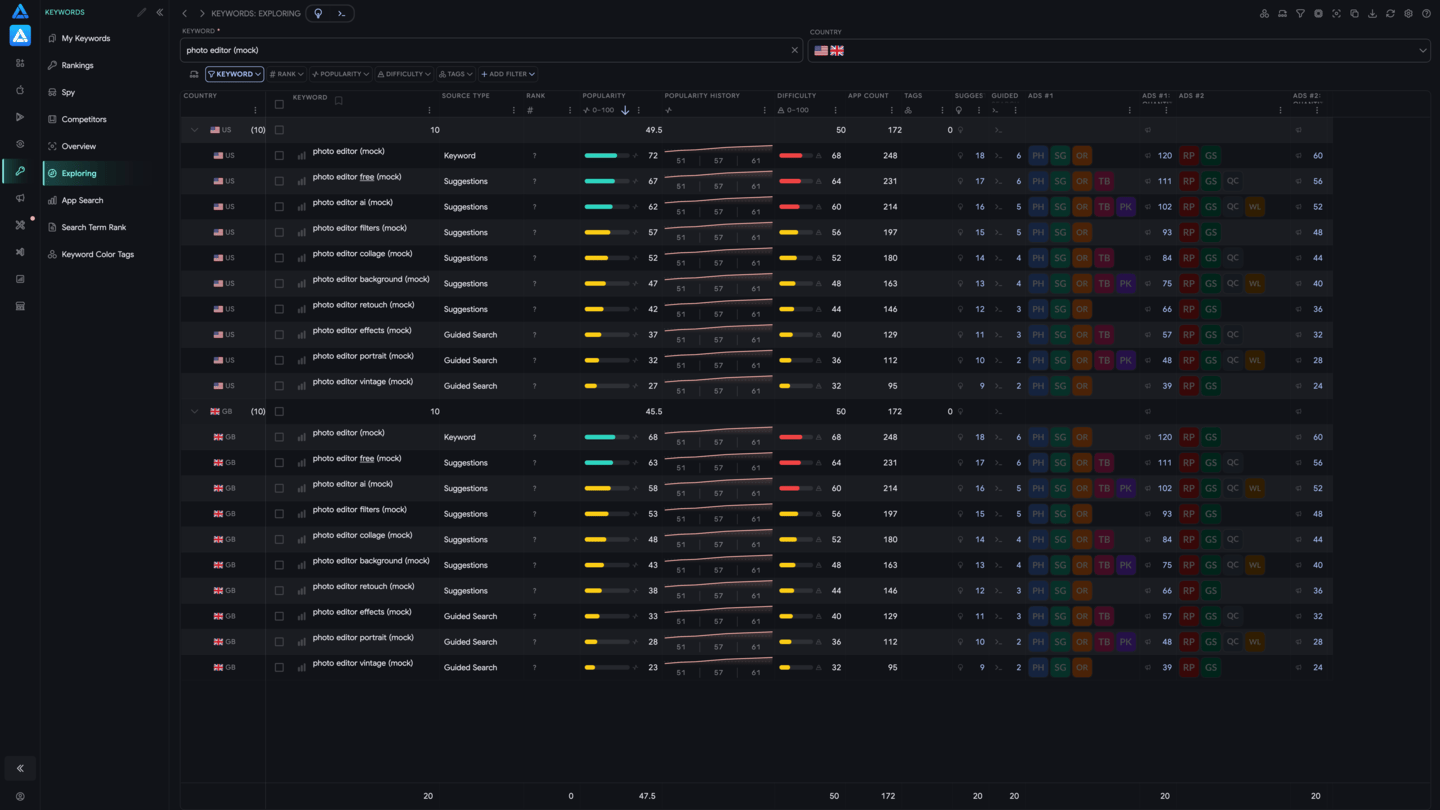
In ASO.dev, you can filter and translate reviews, or export a large archive to CSV for an external AI tool. Spy opens any app’s ranked queries; Keyword Explorer exposes App Store suggestions and Guided Search. Keyword Overview helps validate candidates through search results, popularity, difficulty, and competitors.
In Asodesk, Reviews Board and Tags Analysis help investigate recurring themes. The specialist then collects keywords in Keyword Manager from Missing Ranked, Missing Competitor, Apple Search Ads Suggestions, and Text Analyzer, saving them in Keyword Table. Auto-Suggestions provides Long-Tail, Most Popular, and Least Competitive groups.
The result: a list of needs and candidate queries to investigate—for example, searches for a beginner-friendly habit tracker. A phrase from a review is not automatically a popular search term: check demand and search results separately.
One-click competitor and organic-keyword discovery
Automated ASO.dev Tasks find competitors and organic keywords in one click. Competitor discovery returns up to 50 apps on Indie for your own app, or up to 250 on Pro/Marketing for any app. These limits apply to one automated report, not manual research.
Organic-keyword discovery collects competitors’ shared queries over the last seven complete days: up to 5,000 keywords for your own app on Indie, or up to 20,000 for any app on Pro/Marketing. You can open the combined keyword list from the competitor-discovery task in Keyword Overview.
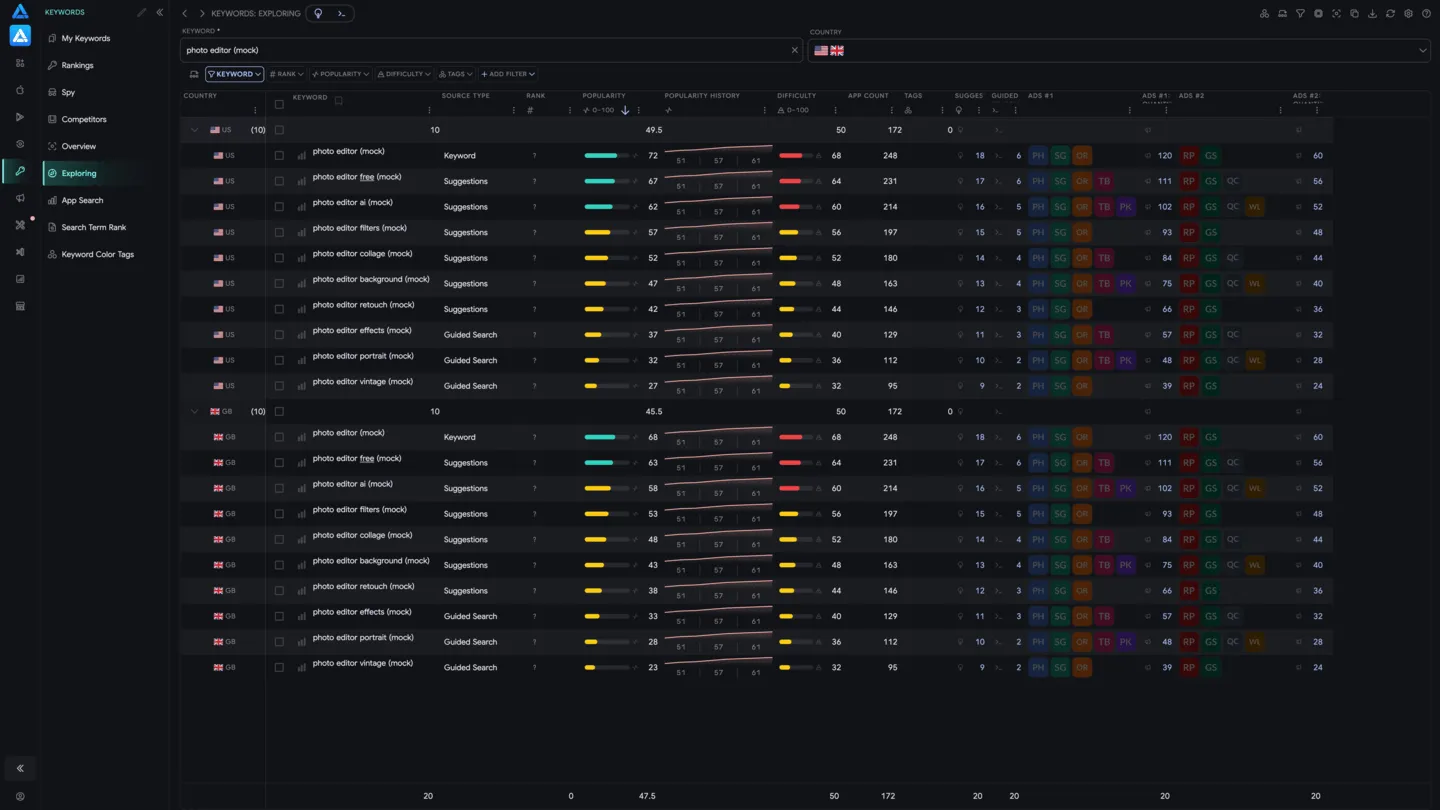
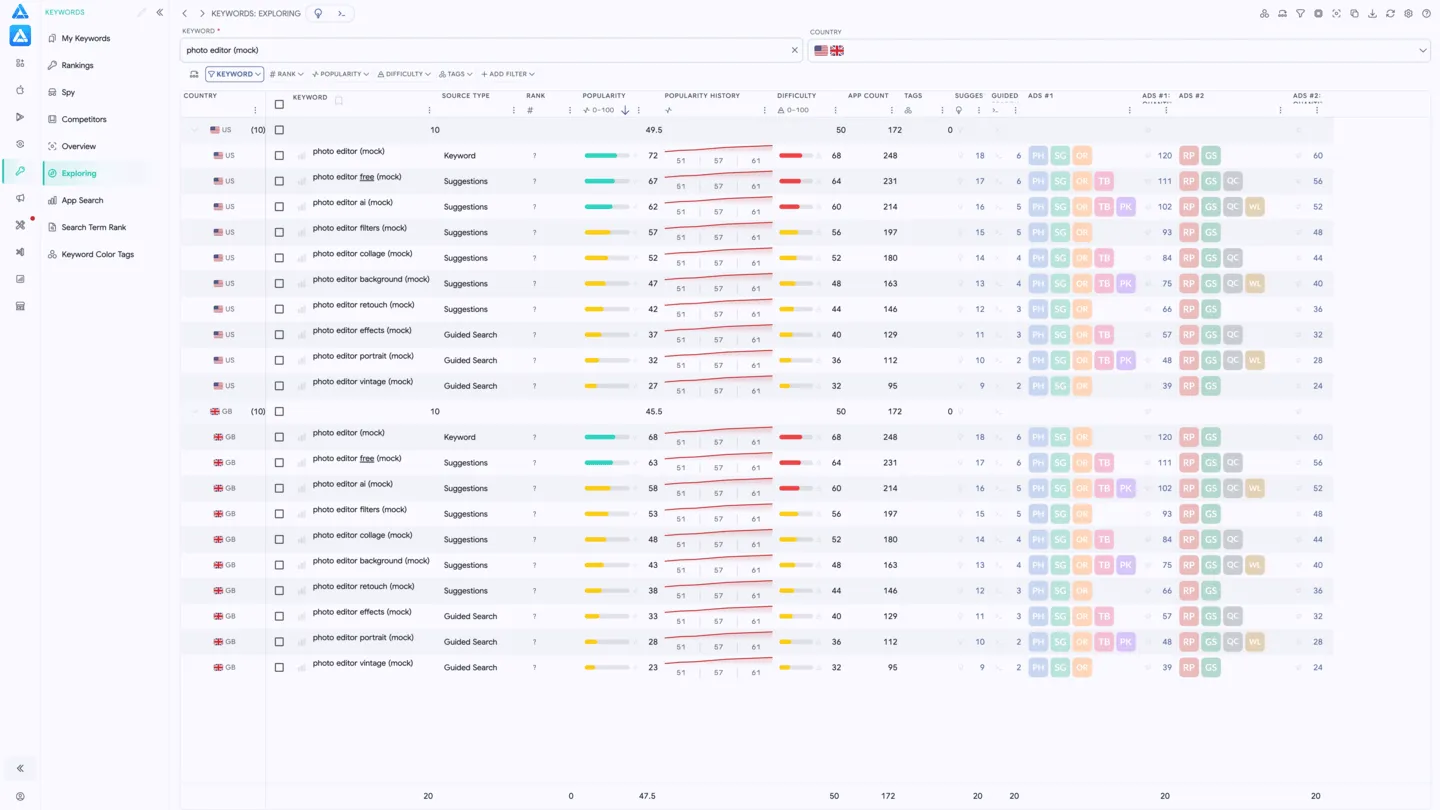
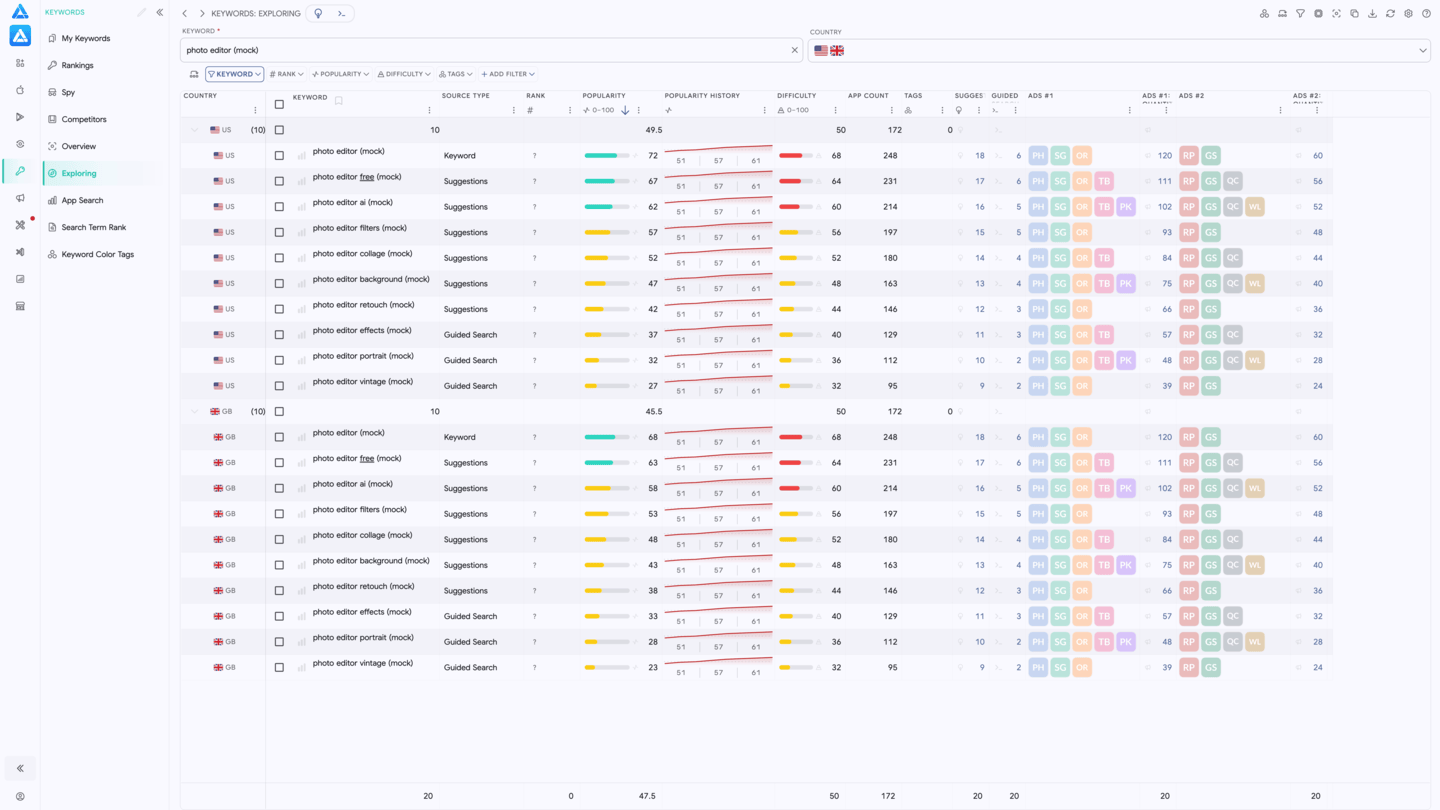
In ASO.dev, move from keyword discovery to an overview of the phrases you found, validate them, and add them to tracking.
Check the idea against competitors. See which apps occupy the search results, how they explain quick start, and what their reviewers are missing. Check the selected country: the same presentation need not work in every locale.
In ASO.dev, rankings are checked on a four-hour schedule, and Competitor Keywords compares positions for the same queries and dates. Other parts of the research use:
- App Competitors for the competitor list; App Clash for metadata and locale comparison.
- Category Ranking for category history by country and platform.
- Changelog for public app changes; SAP Detector for shifts in query popularity.
In Asodesk, Comparative Report is joined by country, public-text, and rating views in Localizations and a separate App Update Timeline. Rankings update at least once every 24 hours.
The result: evidence for a hypothesis, not a collection of similar screenshots. For example, test whether the app’s promise becomes clearer when the first screenshot shows a ready-made habit set. If the feature does not yet exist, product work comes first.
Neither service can see a competitor’s private keyword field. Conclusions come from public metadata, indexing, and rankings.
Prepare copy and screenshots. In this example, compare the current first screenshot with a version showing the ready-made sets. The promise must match a real feature, and the translation must sound natural in the target market.
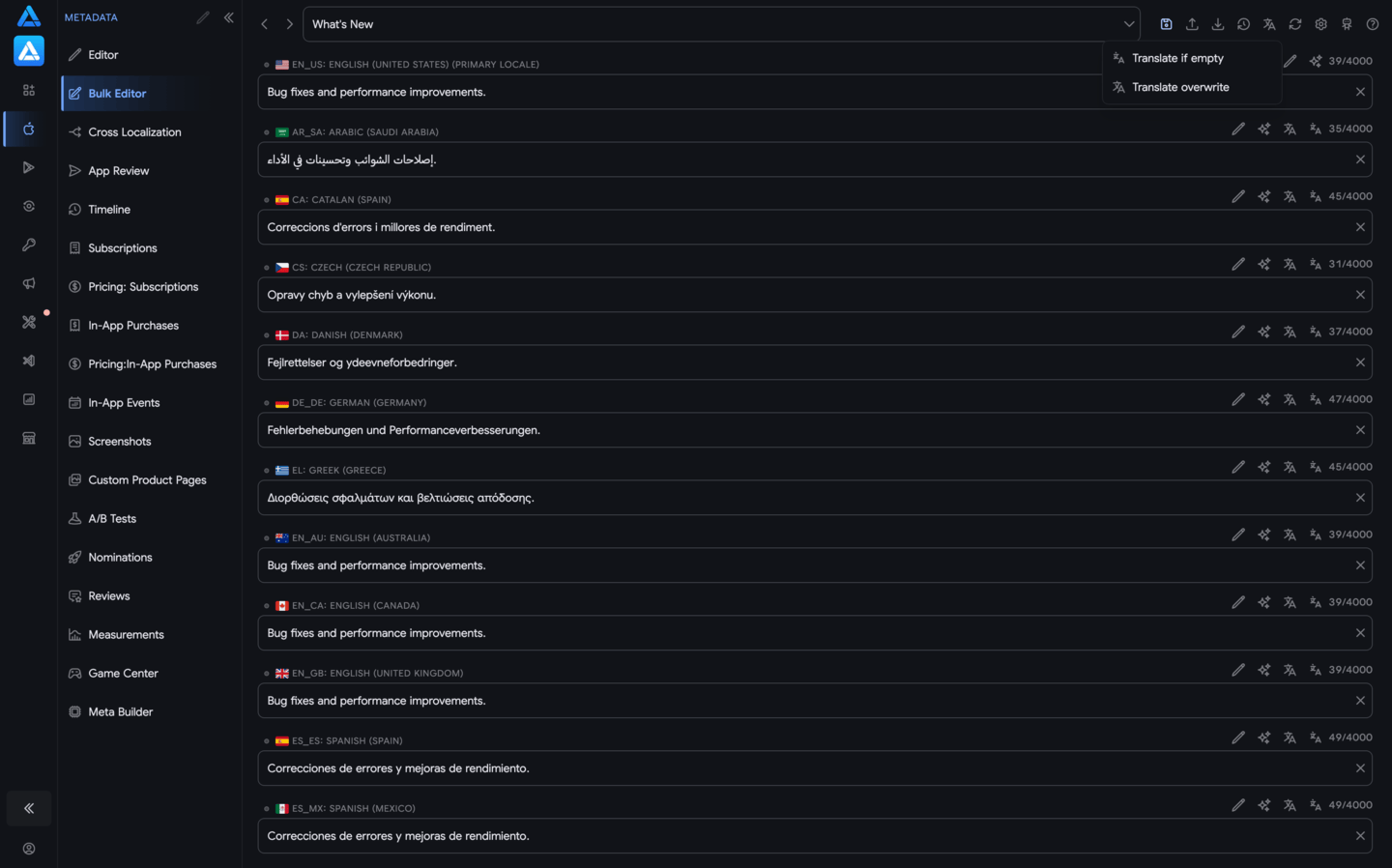
In ASO.dev, the Bulk Editor prepares copy for 50 supported App Store localizations. To avoid moving images one at a time, use the connected tools:
- The Figma plugin exports JSON/ZIP, returns translations to localized frames while preserving Auto Layout, Variables, and RTL, and prepares images by locale.
- Folder import organizes screenshots and videos by locale and device, validates files, and saves progress. After a failure, retry only the failed part.
- The same upload process serves the main page and up to 70 CPPs. Copy localizations, screenshots, and promotional text between custom product pages.
- PPO lets you prepare up to three localized treatments to test the product page’s presentation.
In Asodesk, Visual Comparison and Localizations help research competitor pages and prepare copy and creative briefs. Metadata tools and Release Manager Tools are documented; we could not confirm a comparable end-to-end process covering Figma, bulk image uploads, and CPP/PPO.
The result: localized copy and images ready for review, not just a list of ideas. The team checks translations, line breaks, images, and whether the product delivers on the promise before submitting to the store.
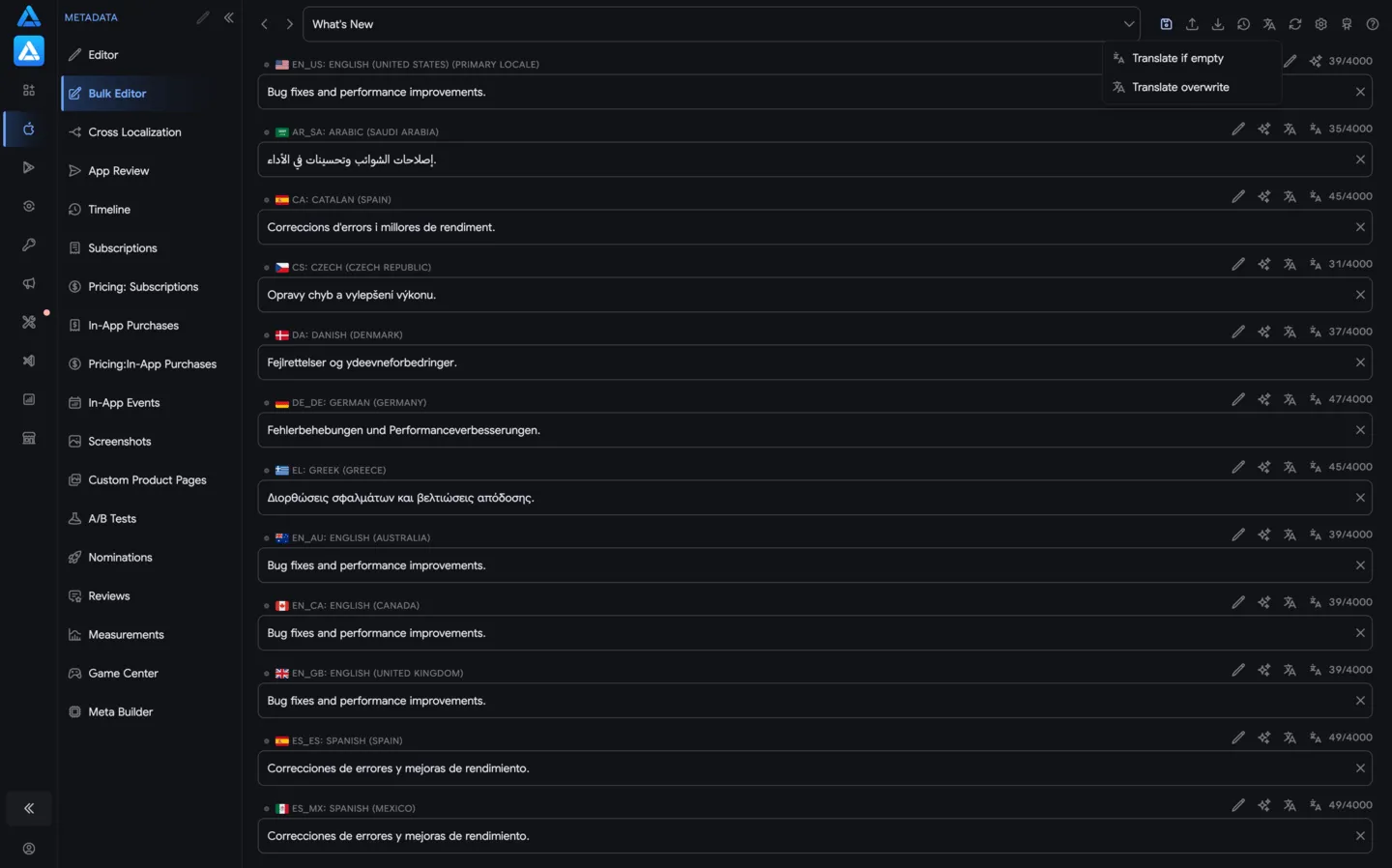
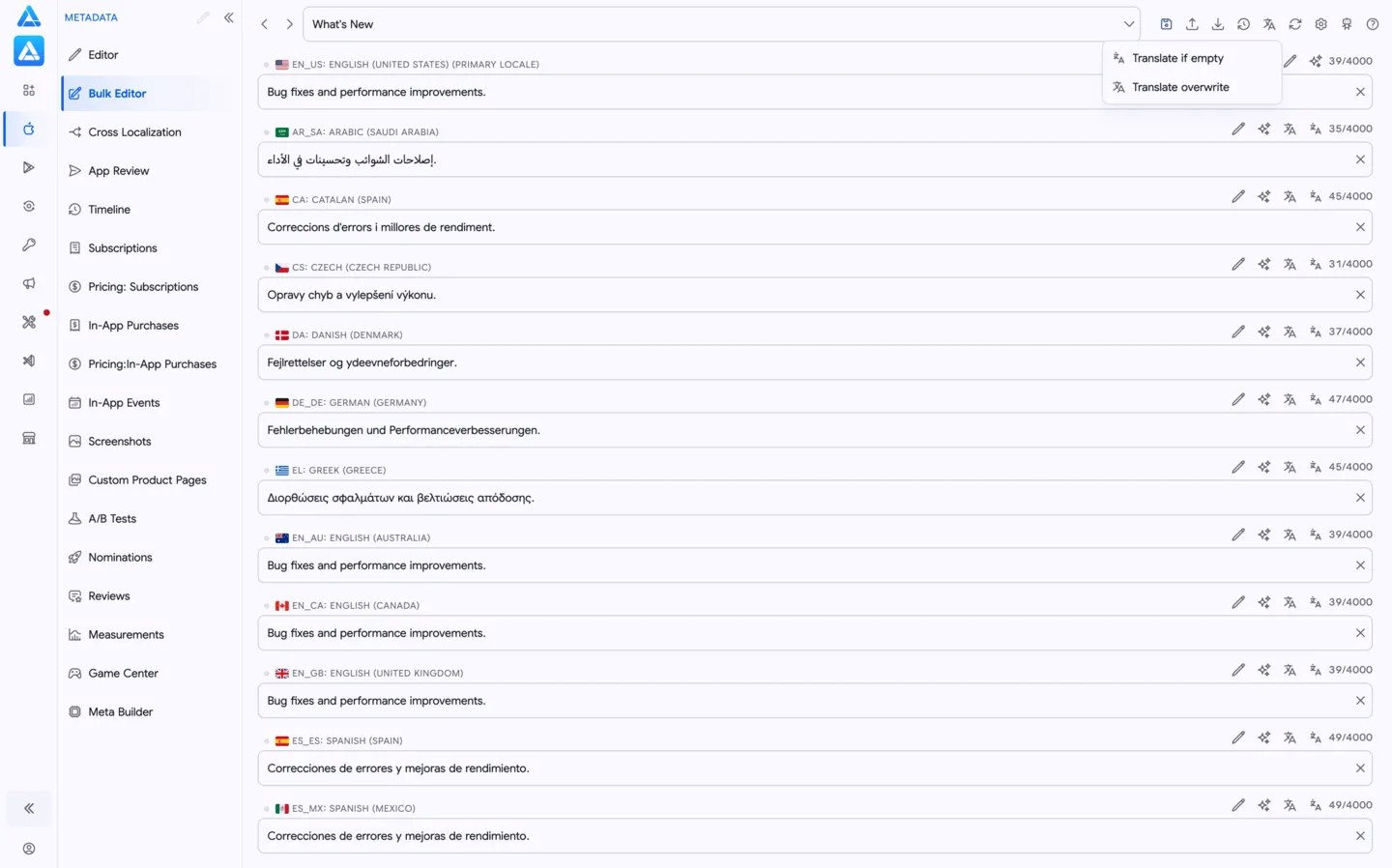
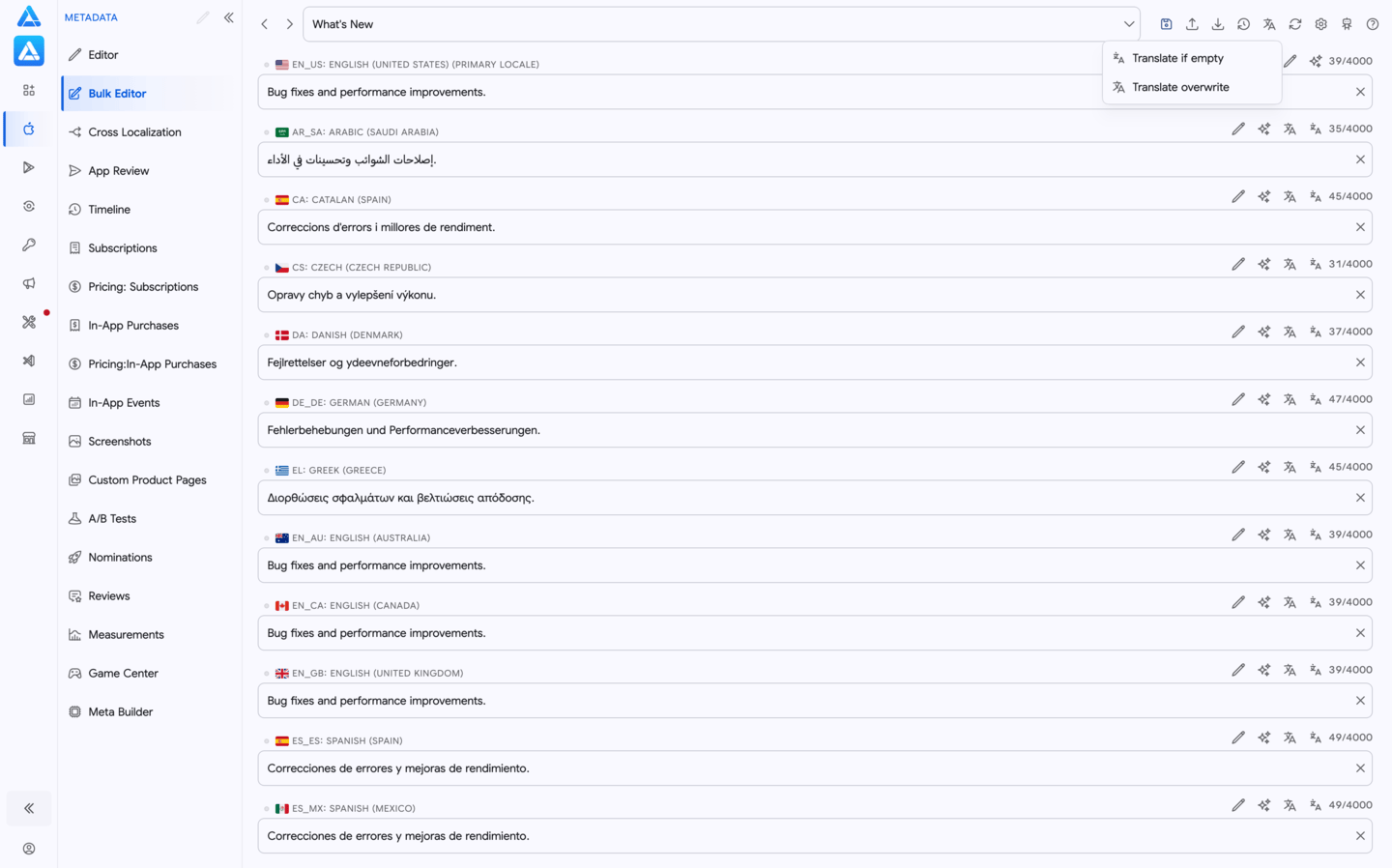
The ASO.dev Bulk Editor displays localized copy in a single table so you can review it before submitting to App Store Connect.
Publish and evaluate. Separate two questions in advance: are people finding the app through the selected queries, and does the new screenshot help them choose it? A higher ranking alone does not prove improved page conversion.
In ASO.dev, the team explicitly saves and submits changes for review, releases the version, and checks App Store Connect metrics. PPO requires an approved app version, and tested icons must be in the binary.
ASO.dev also supports pricing, subscriptions, in-app purchases, and introductory offers. The pricing editor supports bulk changes, import, export, rounding, and purchasing-power-parity scenarios.
In ASO.dev, TestFlight connects builds with testing, while Google Play releases cover Android publishing. We could not confirm an equivalent combined set of pricing, subscription, TestFlight, CPP/PPO, and binary-release operations in Asodesk.
In Asodesk, Keyword Table, Organic Report, and Comparative Report remain available to assess changes. Organic Report’s install estimates add research context but do not replace screenshot experiment results.
The result: evidence to keep a variant, refine it, or reject the hypothesis. In our example, evaluate page presentation through PPO in ASO.dev and separately watch whether new reviews still mention difficult setup. These are related signals, not the same metric.
Working with reviews
Section titled “Working with reviews”In ASO.dev, you can monitor and answer reviews, including with AI, but you initiate and control submission from the desktop app. If support handles a high review volume, Asodesk’s templates, filters, tags, and automatic rules help organize the work.
Asodesk separates ASO plans from review plans. Auto-Replies, Tags Analysis, and helpdesk integrations are listed as additional features; they cannot automatically be counted as included in the Guru or Power prices above. Confirm the cost of the required combination separately.
| Task | ASO.dev | Asodesk |
|---|---|---|
| New reviews | Subscription by app, country, and event; Notifications, push, webhook | Reviews Board and notifications; the list usually updates every 3 hours |
| Replies to stores | App Store and Google Play from the interface | App Store, Google Play, Huawei, and Samsung |
| AI draft | Your AI-provider key, chosen model, and prompt | Templates confirmed; generative AI is unknown from official materials |
| Batch processing | User selects a group; AI sequentially prepares and sends replies | Bulk actions and templates confirmed |
| Autonomous rules | No event-driven server-side reply engine | Approval and Auto-posting; separate access |
| Analysis and export | Filters, translation, CSV for up to 175 countries, external AI | Tags Analysis, sentiment, trends, reports, and exports |
| Integrations | Push; webhooks on Pro/Marketing | Email and Slack; Zendesk and Usedesk are add-ons |
| Store keys | Secure Storage on the device; direct requests or your proxy | Store integration required; key-storage location not publicly described |
Asodesk Auto-Replies rules use review text, rating, language, length, and tags. You can choose approval before sending or Auto-posting without manually confirming each reply. An ASO package’s 100-reply allowance does not establish access to these rules.
Asodesk Reviews Board normally updates the list every three hours, every hour with a helpdesk integration, or every 30 minutes with Google Report a Concern. This is the list-retrieval frequency, not a guarantee of when a reply will be published.
ASO.dev Subscriptions allow 2,500, 6,500, and 13,000 active rules per user on Indie, Pro, and Marketing. A Pro/Marketing webhook delivers the review count, a short preview, and a full-CSV link; the result also remains in Notifications.
The ASO.dev interface filters by country, rating, and reply state, shows reviews updated after a reply, and translates text. In AI settings, users connect their own provider key: ASO.dev does not sell credits per reply, but model tokens and limits are charged separately.
ASO.dev’s local AI Companion MCP reads the current review and loaded list, loads further pages, and prepares, edits, or submits a specific reply. Reporting a review is supported for the App Store, not Google Play; every write action requires explicit confirmApply=true.
A separate ASO.dev Task exports any app’s reviews for selected countries—up to 175—to CSV. For an entire archive, analyze the file with an external AI tool and use MCP for current context and actions, not as access to the entire database.
In ASO.dev, the App Store Connect key and Google Play credentials stay in Secure Storage on your device. Requests go directly to Apple or Google, or through your chosen proxy. You set permissions and can revoke the key.
Securing the device and restricting key permissions remain your responsibility. The ASO.dev server does not continuously hold the key: notifications arrive automatically, while you start reply batches in the desktop app.
To reply from ASO.dev to the App Store, an individual key requires Customer Support, and a team key requires Admin. For Google Play, the service account needs View app information in read-only mode and Reply to reviews. Permissions can therefore be limited to the reply task.
Apple Ads research
Section titled “Apple Ads research”Suppose a competitor shows different screenshots for different queries. In ASO.dev, you can find the associated ad keywords and CPPs, inspect popularity history, and see when we checked the data. This helps reveal which message the competitor presents to different audiences. Advertising tools require Marketing at $1,788 per year.
| Check | ASO.dev | Asodesk |
|---|---|---|
| Organic ranking frequency | Every 4 hours | At least once every 24 hours |
| SAP frequency | Daily through Apple’s official API | Separate SAP frequency could not be confirmed |
| SAP history | Since September 2024; depth depends on plan | Daily history confirmed; depth and plan unknown |
| Check time in the interface | Date and time of the ASO.dev record, not Apple’s change time | General data-update indicator; its specific connection to SAP is unclear |
| Handling of the 2025 anomaly | Publicly described; actual Apple values retained in history | No public description of handling found |
| Ad and media discovery | Query → advertisers, creatives, CPP; app → ad queries and media | SAP and Keyword Stats API confirmed; equivalent media workflow unknown |
We retrieve Apple Ads Search Popularity daily. Daily observation allowed us to be among the first teams to publicly document the global anomaly: in early October 2025, the number of US queries with SAP above 5 fell by 77.4%.
After the anomaly, ASO.dev displays a smoothed average excluding problematic values of 5, while preserving Apple’s actual values in charts and history. You can inspect both the raw data and the smoothed metric. Updates are daily, not real-time.
The SAP tooltip shows the date and time of ASO.dev’s latest record, and clicking opens history. Viewing a query raises its update priority: a stale value may refresh within seconds or by the next day, depending on the queue. Neither date represents the exact moment the metric changed at Apple.
ASO.dev ad discovery works in both directions: search by query to see advertisers, creatives, and CPPs, or by app to see its ad keywords and media. We show Ads 1 and Ads 2; the second ad slot occupies the third overall position in search results.
For a selected creative or CPP, ASO.dev returns up to 5,000 related queries. This helps reconstruct where the visual appeared, but does not provide conversion or financial attribution.
An ASO.dev Share of Voice subscription schedules checks roughly every seven minutes. It covers 200 query-and-country combinations and retains history and check times. Separately, about 45,000 queries with average popularity of 60+ are in ASO.dev’s automatic coverage; the same check frequency is not guaranteed for that pool.
When both make sense
Section titled “When both make sense”In our experience, professional teams often cross-check independent signals from several services. However, a setup with full Organic Report is not automatically economical: Power at $4,110 per year is added to the chosen ASO.dev subscription.
If you want to switch from Asodesk, transfer selected keywords and competitors first, then check whether you still need Estimated Installs or server-side reply rules. Paste keywords into Keyword List in bulk, separated by commas or newlines. There is no automatic two-way synchronization or transfer of Asodesk’s proprietary metrics.
Automating your data work
Section titled “Automating your data work”If you want AI to prepare metadata, start with data: export queries for your app and competitors, remove duplicates, group keywords by user need, and find missing topics. Getting the required rows matters more than simply finding MCP on a feature list.
| Check | ASO.dev | Asodesk |
|---|---|---|
| Official MCP | Local AI Companion, alpha under testing | Could not be confirmed from official sources |
| MCP capabilities | Current screen and loaded context: metadata, locales, reviews, confirmed actions | Unknown |
| MCP API-credit usage | Does not consume Developer API credits | Unknown; an official MCP is unconfirmed |
| 20,000+ keywords for one app | Pro/Marketing: yes, if the report contains that volume | Organic XLSX available; public 20,000+ limit unknown |
| Multi-app keyword intersections | Competitor Keywords on Pro/Marketing: 20,000+ rows if present in the result | Separate reports available; one 20,000+ intersection export unconfirmed |
| Format and working table | XLSX/CSV; one loaded dataset for filtering and export | Organic and Comparative XLSX; general UI pagination policy unknown |
| API | Closed alpha from Pro; credits, cost estimate, no SLA | Public REST/JSON; separate credit packages |
| Practical route | Export → external AI → MCP actions | Organic/Comparative XLSX → external AI; REST after calculating credits |
The ASO.dev desktop client for macOS, Windows, and Linux loads a large result into one working view. Specialists filter, sort, select, and export the dataset without manually assembling pages. Reviews and TestFlight separately load pages from external APIs.
On ASO.dev Pro/Marketing, app keyword analysis and competitor-keyword comparison may contain thousands, tens of thousands, or, in some reports, hundreds of thousands of rows. Shared queries and gaps are visible through the selected apps’ positions in one table. Result size depends on the report; automated Task limits appear in the working example.
ASO.dev MCP works with the current workspace and editor, bulk-fills supported fields, and requires confirmation of actions. It is not a bulk keyword endpoint and does not consume Developer API credits; the external model is paid for through its provider.
ASO.dev Developer API is a separate closed alpha available from Pro. Confirmed surfaces include app data and metadata, current and historical rankings, popularity, top category positions, review queries, and keyword tracking. Requests use credits; cost estimation does not consume them. API contracts and limits may change, and there is no SLA.
In alpha, we test methods, load, data quality, and pricing mechanics. Recurring server-side processes need to accommodate contract changes.
We could not confirm a 20,000+ row export or the terms for a unified multi-app union or gap export across countries from Asodesk’s official materials. Request those parameters before building a bulk-data process.
Asodesk’s public REST API is available to the root account, issues a 24-hour token, and uses separate credits. Packages of 5,000, 20,000, 100,000, and 300,000 credits cost $39, $99, $399, and $899 before the 15% annual discount.
Asodesk’s Auto-Suggestions API method works for one app, country, and store, returns 100–1,000 rows per page, and costs from 300 credits; the statistics parameter adds 10 credits per keyword. Total page limits, availability of 20,000 actual rows, and a public rate limit are not disclosed.
A practical ASO.dev bulk-data route:
- Export XLSX/CSV and clean, deduplicate, or cluster the file in Codex, ChatGPT, or Claude.
- Paste the selected queries into Keyword List in bulk, separated by commas or newlines.
- Use local MCP for current-editor context and actions, and Developer API for recurring server-side processes.
MCP transport and boundaries
AI Companion connects locally to the ASO.dev app over HTTP at localhost:42111; clients using stdio connect through an npx bridge. A client secret can be enabled. This is a local assistant for the active screen, not Developer API or a universal data server.
Frequently asked questions
Section titled “Frequently asked questions”Will one plan cover 10 apps?
Yes. One ASO.dev Pro seat lets you work with all ten apps; specialized automations keep their own quotas. Asodesk Guru covers capacity, but full Organic Report needs Power, and country-based keyword counting may require Custom.
What would I lose by switching from Asodesk?
Modeled Estimated Installs, Tags Analysis, Huawei/Samsung support, and server-side reply rules do not transfer one-for-one. Keyword research, long-tail discovery, locale comparison, and change history remain available through ASO.dev tools. If you use Asodesk’s page-update alerts, check that step separately before switching.
Does MCP consume API credits?
Not in ASO.dev; the external model is paid separately. An official Asodesk MCP is unconfirmed. See data automation for the terms.
Can I export 20,000+ keywords?
Yes, in supported ASO.dev Pro/Marketing reports when the result contains that volume. Task limits and Asodesk’s unknown parameters are listed in the export comparison.
Can I use both without technical integration?
Yes. Export or manually transfer selected keywords and competitors; see the combined setup.
Do I need a technical specialist?
For research, localization, publishing, or replies in ASO.dev, the interface is enough: you do not need a technical specialist. A developer is needed for server-side API work, custom webhook handling, or other bespoke automation.
The verdict
Section titled “The verdict”- ASO.dev Pro fits as a specialist’s primary working hub: keyword research, competitors, large exports, and the path from a hypothesis through 50 localizations to release. Apple Ads requires Marketing.
- Asodesk fits teams needing modeled Estimated Installs, an established review suite, alternative stores, and a public REST API.
- Both are justified when Asodesk’s additional model is needed on a limited scope, while ASO.dev handles broad research, tracking, and store changes.
If ASO.dev is missing something you need, suggest an idea and vote, or write to hello@aso.dev. Tell us what you want to achieve and how you do it today: we welcome suggestions and consider them as we develop the product.
Method and sources
Section titled “Method and sources”Prices are in US dollars before tax. Calculations use equivalent workloads; the habit-app example is a modeled working process, not a measured customer result. We review the article quarterly.
Official-source verification dates:
- August 2, 2026: main review of features, reviews, ads, MCP/API, and exports.
- August 19: prices and Organic Report plan access.
- September 4: Keyword Manager, Auto-Suggestions, Localizations, App Update Timeline, and Visual Comparison.
- September 7: Organic Report’s two modes and ASO.dev Task plan limits.
- September 8: ranking frequency, Daily Keyword Stats, app/keyword/user allowances, and Custom terms.
- October 4: ASO.dev plan names, separate access to Asodesk review automation, and scheduled Report: App Overview.
Official Asodesk materials:
- Plans and quotas: Pricing, Custom Plan, Major update to Asodesk plans, Find & Track: Keyword Table, Daily Keyword Stats.
- Research: Keyword Manager, Organic Report and its FAQ, Organic Report Export, Auto-Suggestions, Localizations, App Update Timeline, Report: App Overview, Custom Reports and Notifications, Visual Comparison.
- Reviews and API: Reviews Board, Auto-Replies, Tags Analysis, Integrations, API, API Pricing, Keyword Auto-Suggestions API.
ASO.dev materials: pricing, ASO documentation, Bulk Editor, Figma Localization Plugin, reviews, Subscriptions, Notifications, Apple Ads Insights, SAP/SOV, AI Companion MCP, and Developer API. Contextual documentation links appear in the relevant sections.