
ASO.dev vs AppTweak in 2026: Which Should You Choose?
AppTweak combines App Store and Google Play research, market estimates, and reporting. At ASO.dev, we connect App Store research with everyday work on apps: selecting keywords, localizing content, preparing screenshots, handling reviews, and publishing. The choice depends on the data you need, the size of your portfolio, and where you prepare store updates.
By the ASO.dev team. Prices and quotas checked on September 8, 2026.
| Your task | What to consider |
|---|---|
| Manage a broad App Store portfolio | ASO.dev: apps, keyword lists, and manually added competitors within one seat |
| Prepare localizations and publish | ASO.dev: text and media editors, submission to App Store Connect |
| Work with Apple advertising | ASO.dev Marketing: frequent monitoring; AppTweak: Ad Intelligence and a separate Campaign Manager |
| Reply to reviews | ASO.dev: your chosen AI model and processing started by the user; AppTweak: rules and integrations |
| Research Google Play | AppTweak: Android keywords and search metrics |
| Assess the market and prepare reports | AppTweak: download and revenue estimates, data from several sources |
The main difference
Section titled “The main difference”AppTweak sells several modules: ASO Intelligence for store research, Market Intelligence for market estimates, Reporting Studio for reports, App Reviews Manager for reviews, and Campaign Manager for advertising. What your subscription includes depends on the modules and plan you choose.
At ASO.dev, a subscription covers one specialist. In the ASO section, you can expand your portfolio, keyword lists, and manually added competitors without buying additional seats for each item. Connected developer accounts and workspaces are included in the same seat. Data history, automated Tasks, Subscriptions, and the API have their own limits.
Research and preparation are available in one app: the App Store editor and Google Play editor work with your store accounts. ASO.dev also supports TestFlight builds and Apple Developer account management.
AppTweak strengths
Section titled “AppTweak strengths”- Android research. ASO Intelligence works with the App Store and Google Play and covers more than 100 countries. ASO.dev currently has no comparable Google Play keyword research.
- Market estimates. Market Intelligence estimates downloads, revenue, and market share. This helps you choose a category, country, or app for further research.
- Consolidated reporting. Reporting Studio combines data from AppTweak, store accounts, Apple Ads, and mobile measurement partners (MMPs). Teams can prepare reports from several data sources.
- History and enterprise features. ASO Intelligence advertises 6, 12, and up to 24 months of history, depending on the plan and metric. Enterprise adds metadata suggestions through ASO Agent, consulting, and shared workspaces. The separate AI Visibility product tracks app recommendations in ChatGPT and Gemini.
- Team review management. App Reviews Manager includes topic and sentiment analysis, templates, team metrics, and integrations with Slack, Zendesk, and Salesforce. Reply Automation on Enterprise can send replies according to rules.
ASO.dev strengths
Section titled “ASO.dev strengths”- Large portfolios. The number of apps you research, keyword lists, and manually added competitors does not increase the seat price.
- Large tables. In the desktop client for macOS, Windows, and Linux, you can filter, sort, and export the data you find in one table. Exports are available on Pro and Marketing.
- Localization and publishing. The Bulk Editor and screenshot upload tools help prepare updates for 50 localizations and submit them to App Store Connect.
- Frequent ad monitoring. On Marketing, ads by keyword and app advertising connect queries, advertisers, images, and Custom Product Pages. Selected SOV queries are checked about every seven minutes.
- AI in the editor and reviews. The local AI Companion connects your chosen assistant to current data and actions. You review and confirm changes before sending them.
Portfolio costs
Section titled “Portfolio costs”For a specialist with 10 apps and regular data exports, Pro costs $89 monthly or $828 per year. Indie costs $39 monthly or $348 per year and includes 30 days of detailed history. Pro adds 60 days of detailed history, exports, Custom Product Pages, App Clash, and Changelog.
Below, we compare subscriptions for one specialist, one tracked country per app, and up to 500 review replies per month. Amounts are in US dollars and exclude taxes, external AI services, advertising budgets, and consulting.
| Scenario | ASO.dev | AppTweak |
|---|---|---|
| 1 app, research | Indie $348/year; Pro $828/year | Essential $949/year |
| 10 apps × 50 keywords + replies | Pro $828/year | Grow + Reviews Small $3,980/year |
| 10 apps × 200 keywords + replies | Pro $828/year | Grow or Grow Plus + Reviews Small $3,980–6,980/year |
| 50 apps, research | Pro $828/year per seat | ASO Intelligence: Enterprise, custom pricing |
In AppTweak, the plan you need depends on the actual number of tracked keywords, accounting for country, language, and duplicates. For ten apps with 200 keywords each, Grow may suffice if usage stays within 1,500 quota units; 2,000 distinct queries require Grow Plus.
ASO.dev Pro for two specialists costs $1,656 per year. Marketing costs $199 monthly or $1,788 per year per seat and includes Apple Ads research. Campaign management is available in AppTweak’s separate Campaign Manager.
AppTweak plans and costs for several countries
ASO Intelligence plans differ in the number of tracked keywords, apps, and competitors. Adding a country for the same app in the same store keeps one unique ID in the app quota.
| AppTweak plan | Annual price | Keywords | Apps | Competitors per app | Seats | Advertised history |
|---|---|---|---|---|---|---|
| Essential | $949 | 500 | 5 | 5 | 1 | 6 months |
| Grow | $2,990 | 1,500 | 10 | 10 | 1 | 12 months |
| Grow Plus | $5,990 | 3,000 | 15 | 15 | 1 | Up to 24 months |
| Enterprise | Custom pricing | By agreement | By agreement | By agreement | By agreement | By agreement |
With monthly billing, Essential, Grow, and Grow Plus cost $99, $299, and $599 respectively. Reporting Studio includes 10, 15, and 20 reports; shared workspaces are available on Enterprise. AI Visibility and consulting have separate terms.
App Reviews Manager: Small costs $990 per year for 500 replies per month; Medium costs $2,990 for 1,500; Large costs $9,990 for 5,000. Monthly prices are $99, $299, and $999. All three include five seats and unlimited apps. Automated reply rules are available on Enterprise.
For five countries, research costs depend on how much the lists overlap:
- 10 apps with distinct lists of 50 keywords: 2,500 tracked queries; Grow Plus + Reviews Small costs $6,980 per year.
- 10 apps with distinct lists of 200 keywords: 10,000 queries; an Enterprise quote is needed.
- 10 apps sharing 200 keywords: if duplicates across apps count once, this uses 1,000 quota units across five countries and fits Grow. Confirm the deduplication rule in Company Usage: FAQ Keyword Tool describes it for lists and users, while the list instructions explicitly guarantee it only within one app.
For 501–1,500 replies per month, Reviews Medium is needed: Grow + Medium costs $5,980 per year, Grow Plus + Medium costs $8,980. Market Intelligence Free provides basic estimates for the previous month; Explore costs $6,590 per year.
Keywords
Section titled “Keywords”Discovery and selection
Section titled “Discovery and selection”AppTweak offers unlimited keyword discovery and separate tracking of selected queries with history. Essential, Grow, and Grow Plus include 500, 1,500, and 3,000 tracked keywords respectively. Difficulty and ranking opportunity estimates help with selection; Grow adds relevance and organic installs per keyword estimates.
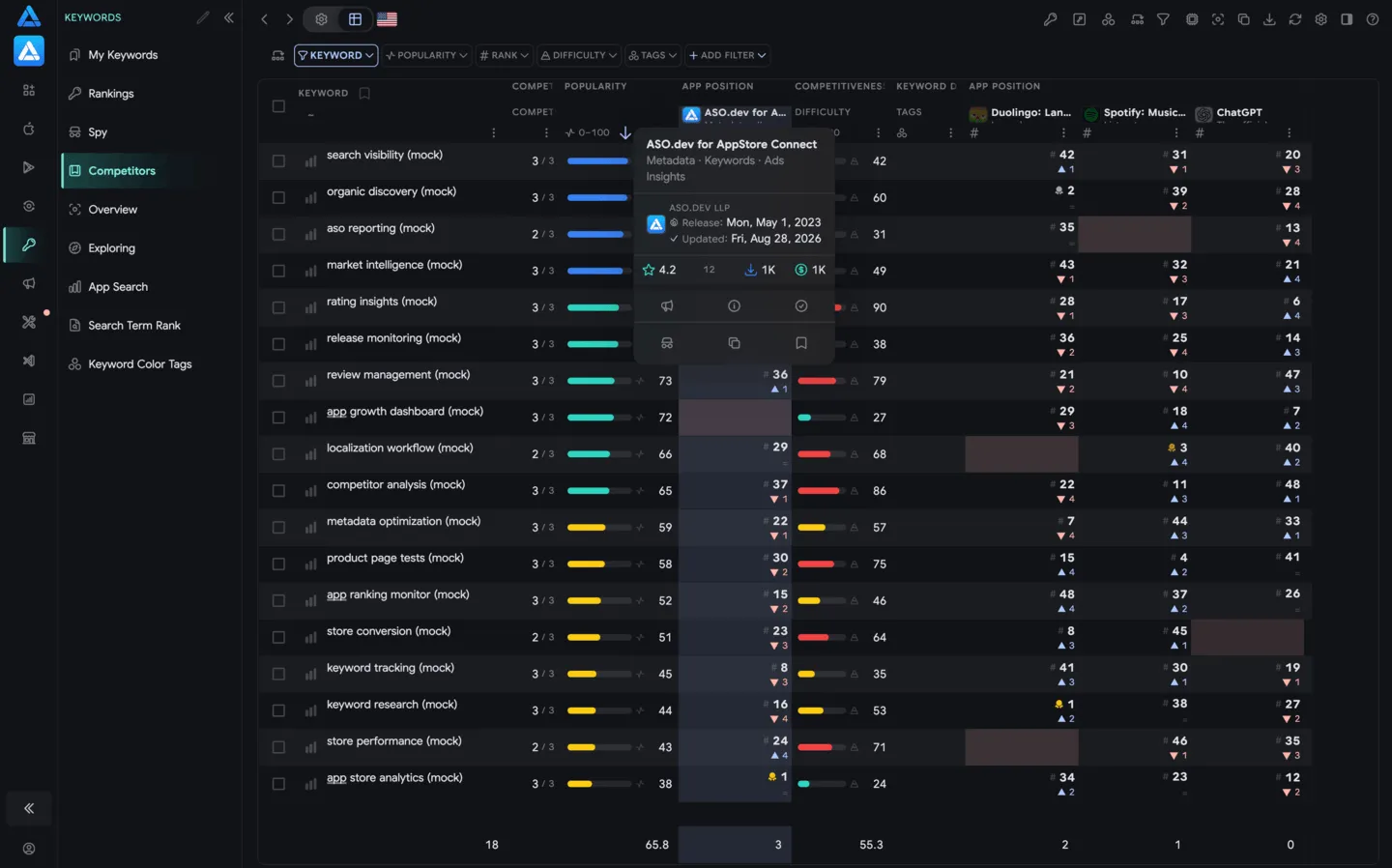
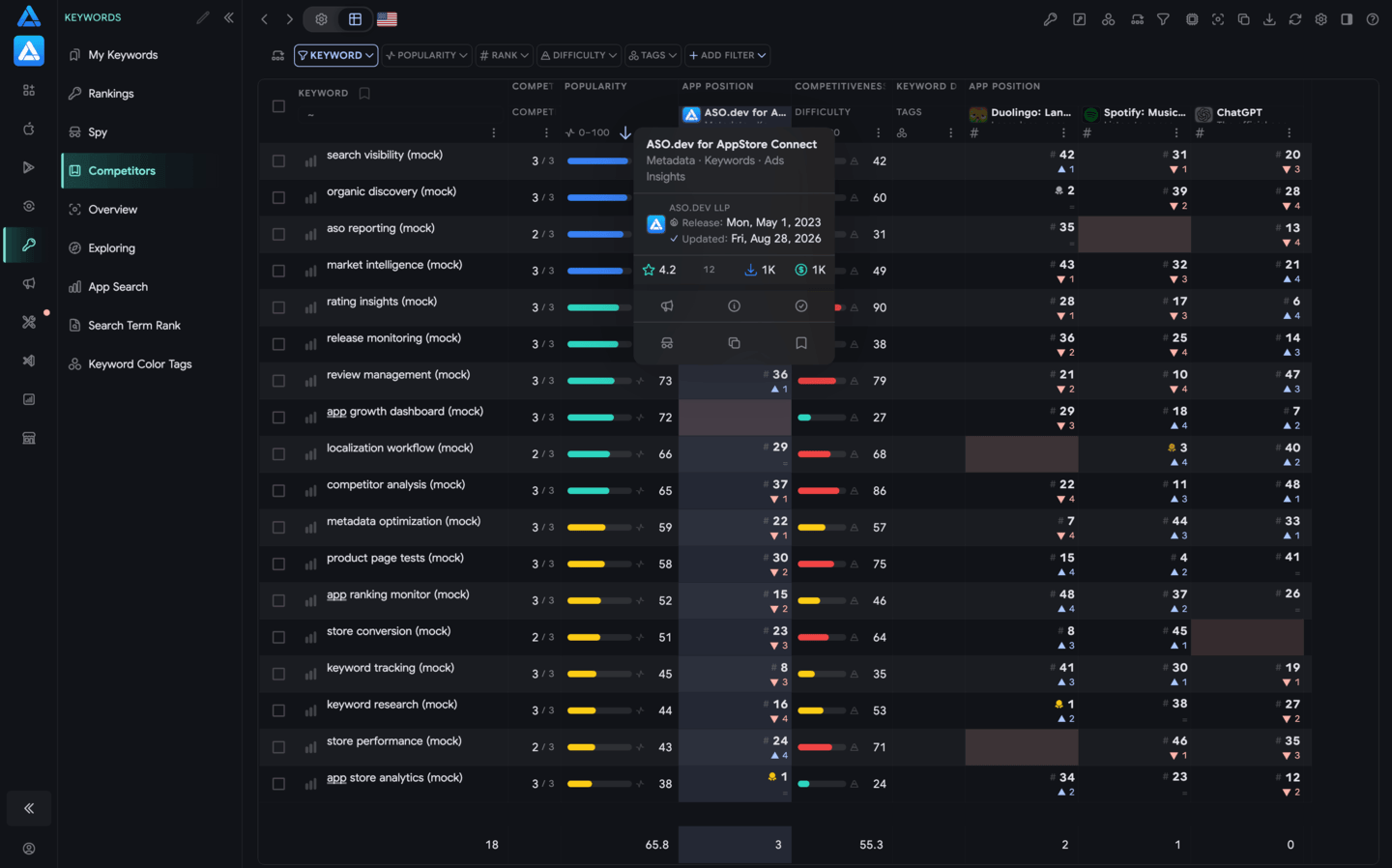
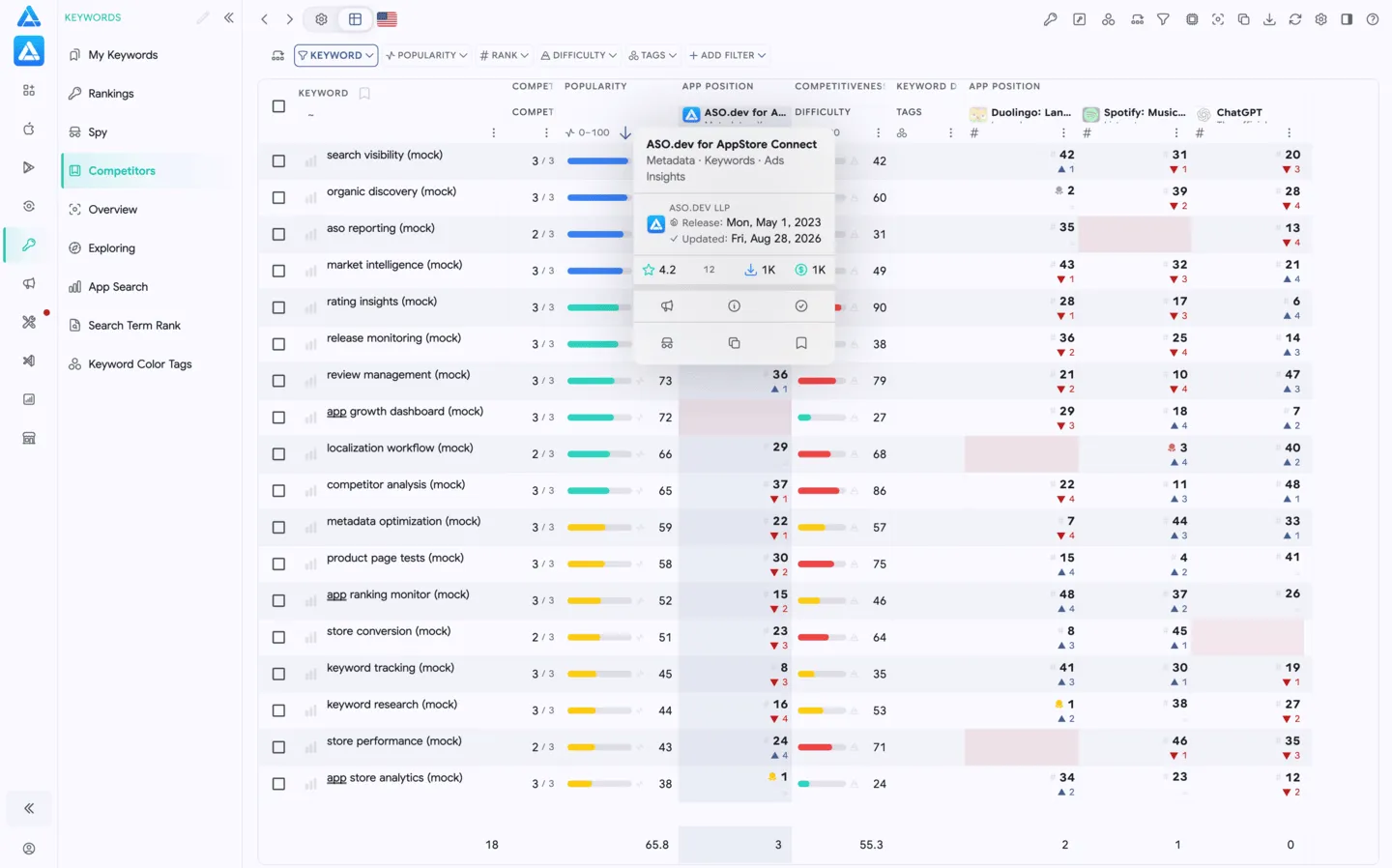
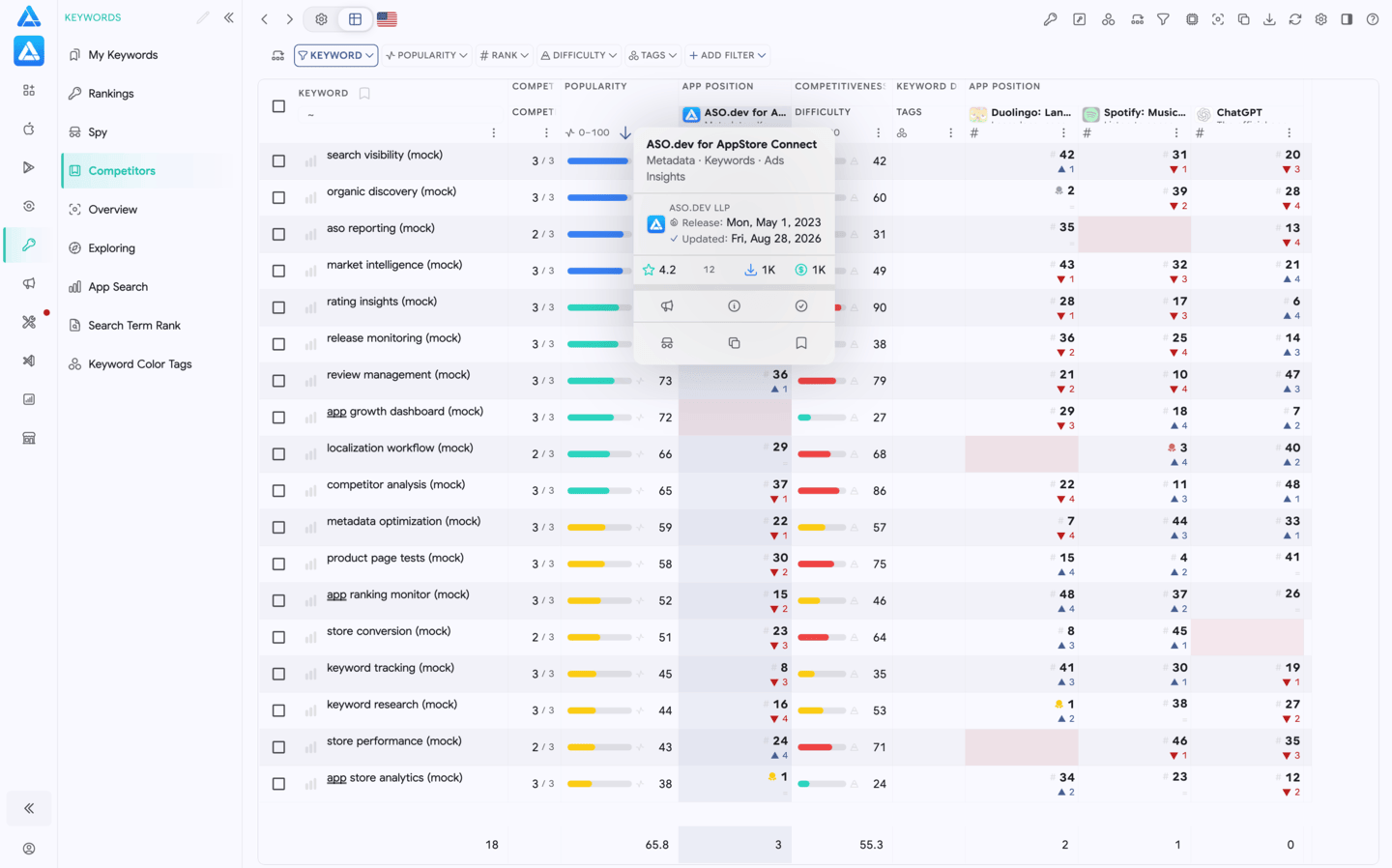
In ASO.dev, Keywords Overview shows App Store search results, query popularity, ranking difficulty, and the number of apps. The Competitors Table compares several apps’ rankings for selected keywords. These data help you find queries where competitors already appear and assess opportunities for your app.
Competitor Search returns up to 50 apps on Indie for your own app and up to 250 on Pro or Marketing for any app. Find Organic Keywords uses competitor data from the last seven days: up to 5,000 keywords on Indie and up to 20,000 on Pro/Marketing.
You can add selected keywords to the tracking list in bulk. The screen below shows your app and competitors’ rankings for the same queries.
History and updates
Section titled “History and updates”ASO.dev rankings update every four hours. AppTweak’s key metrics table updates every 24 hours. When comparing longer periods, the data type and plan matter:
| Data | ASO.dev | AppTweak ASO Intelligence |
|---|---|---|
| Detailed ranking history | Indie: 30 days; Pro and Marketing: 60 days | Essential: 6 months; Grow: 12; confirm the Grow Plus period |
| Trend charts | Pro and Marketing: since September 2024 | Period depends on the plan and metric |
| Apple popularity | SAP history since September 2024; access depends on the plan | Search Popularity and Volume Estimate history with the method change marked |
Detailed history lets you view rankings on individual dates; trend charts show changes over a longer period. If you need to compare detailed rankings over six months or a year, check that period before choosing a subscription.
Localization and publishing
Section titled “Localization and publishing”AppTweak helps research local markets, compare competitors’ metadata and images, see their tests, and prepare page previews. In ASO.dev, you can prepare the selected copy and media for submission to the store directly.
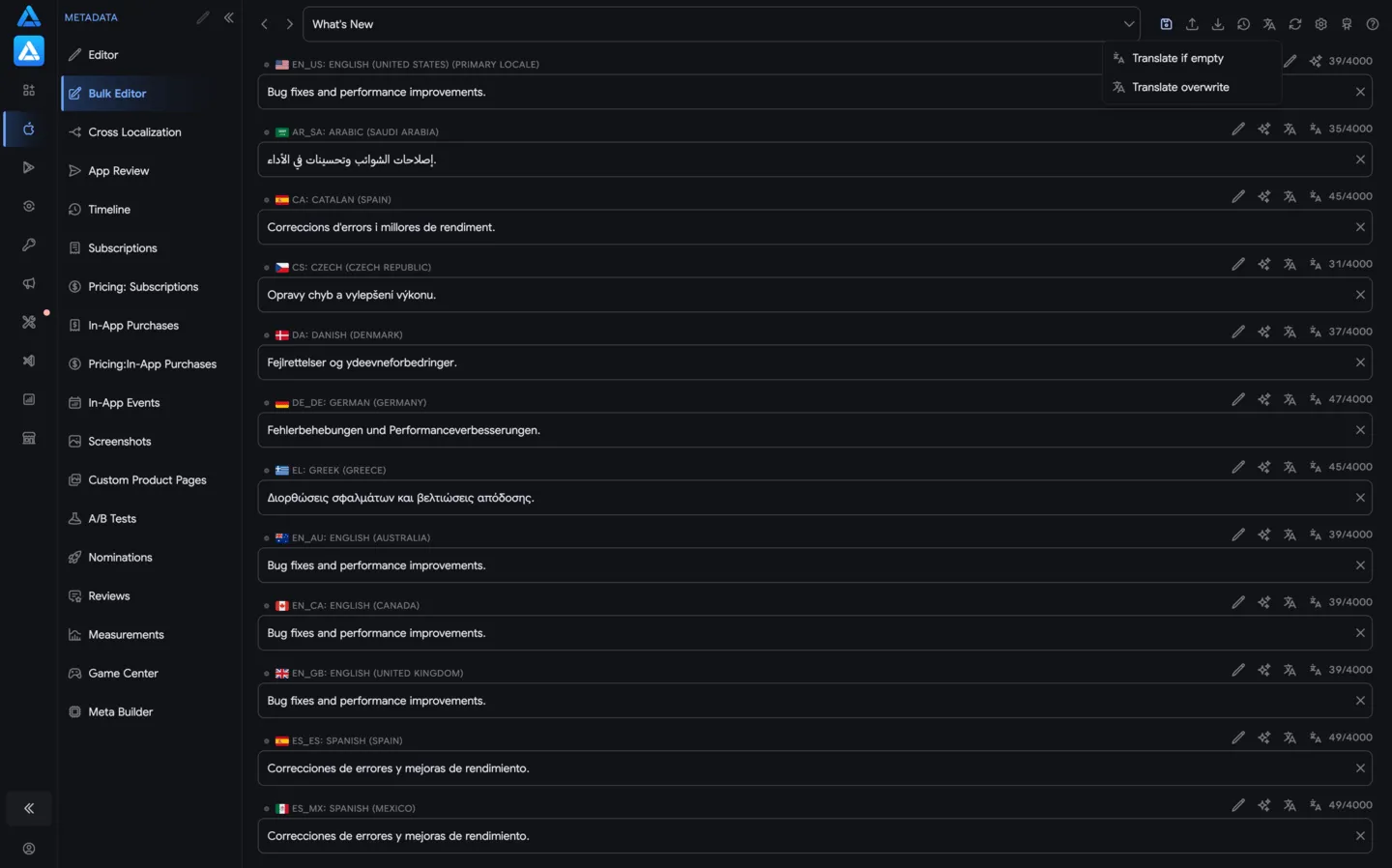
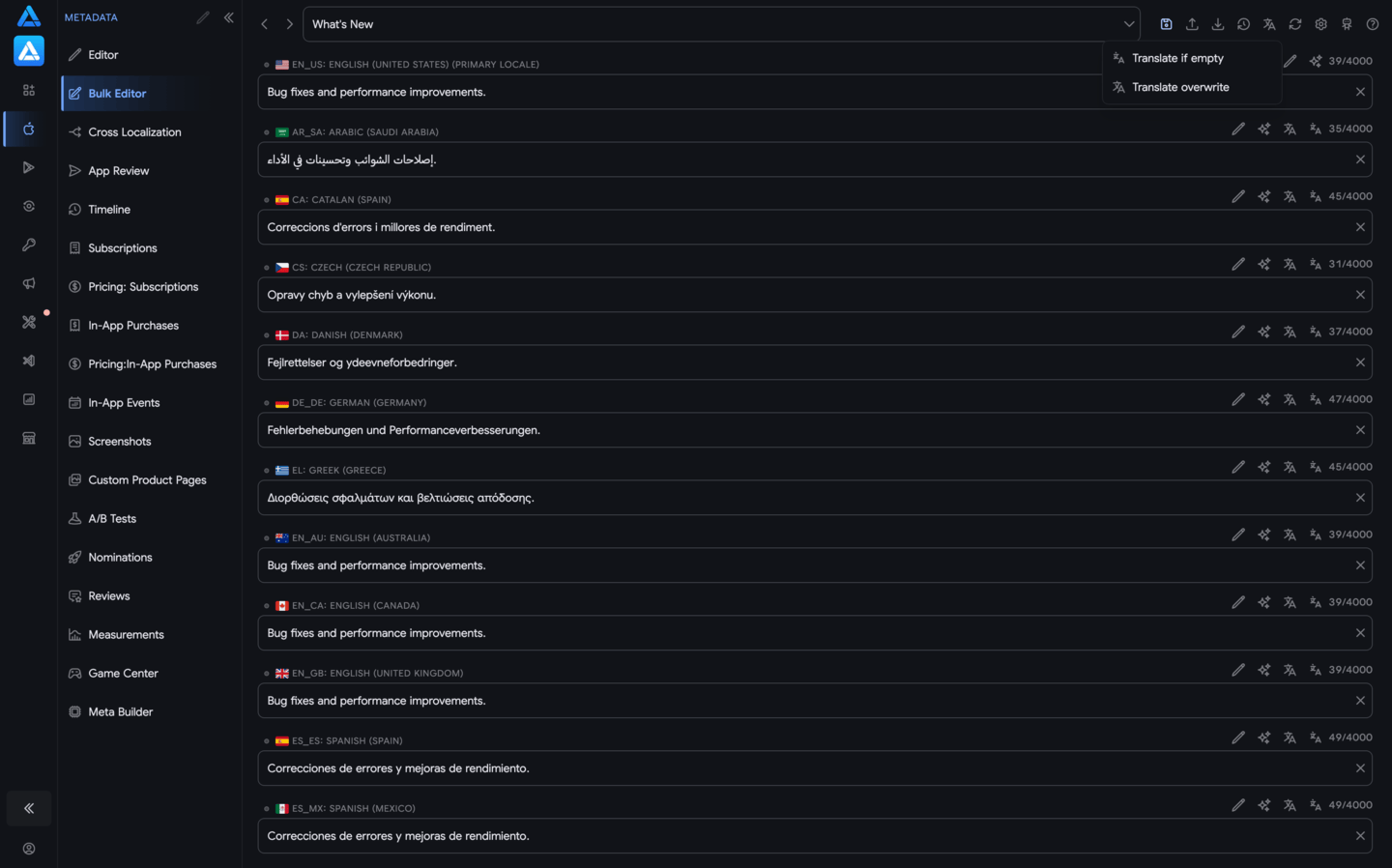
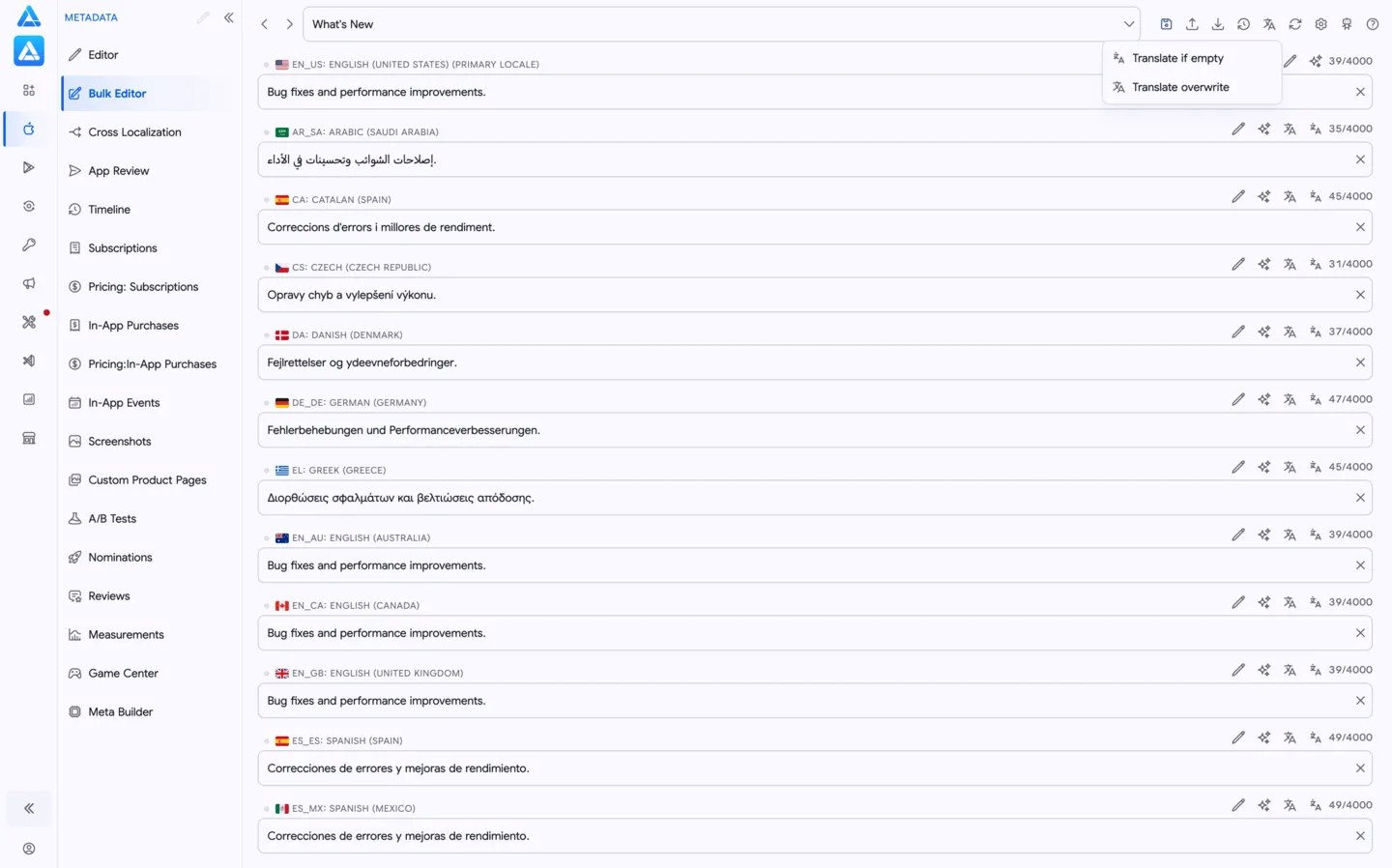
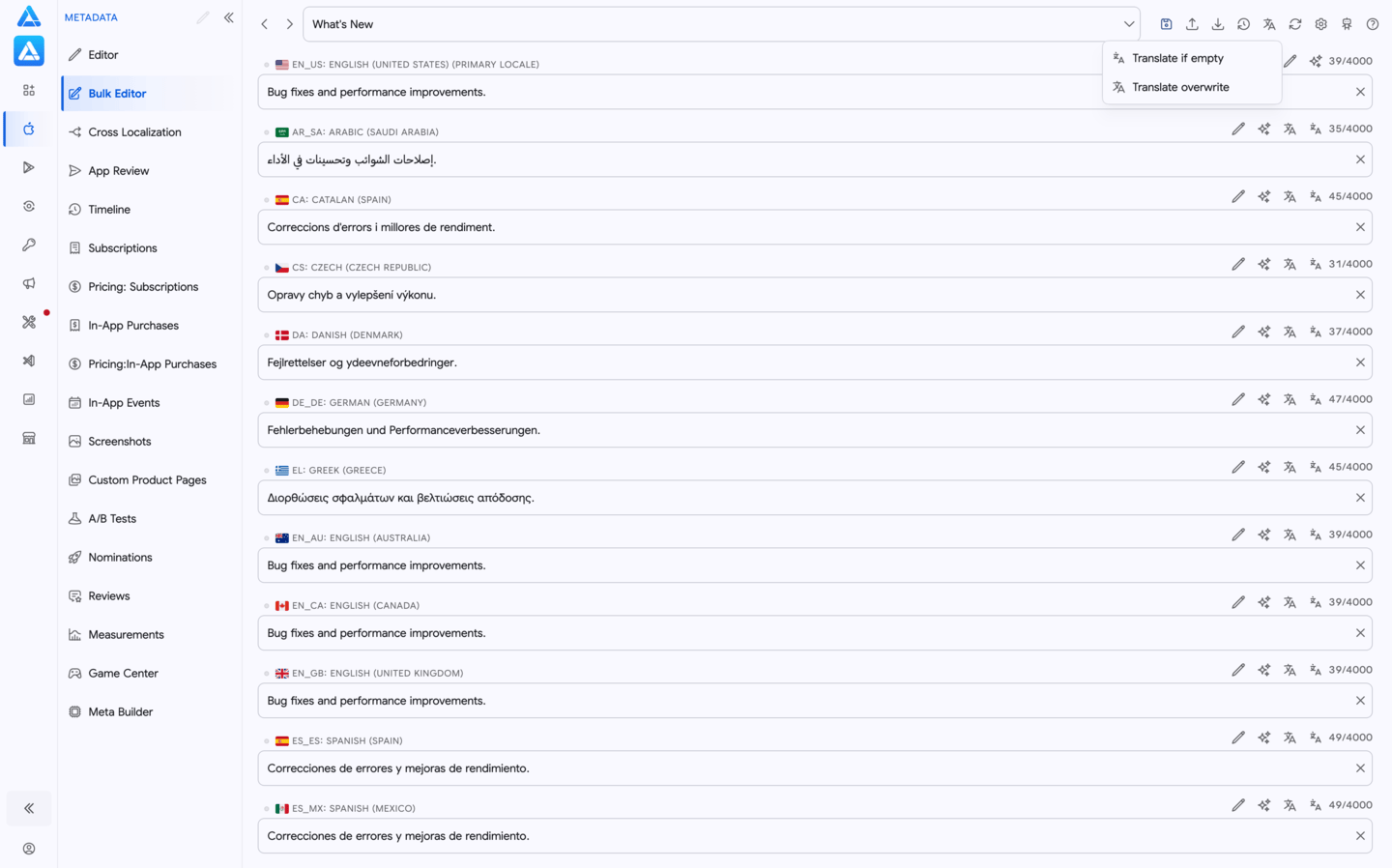
The Bulk Editor translates, edits, and validates copy for 50 supported App Store localizations. All localizations are available together in one table.
- Figma designs. The free localization plugin transfers copy through JSON or ZIP and updates frames while preserving Auto Layout, Variables, and right-to-left text direction.
- Screenshots and videos. Folder import assigns files to localizations and devices, validates them, and lets you retry failed uploads.
- Custom pages. On Pro and Marketing, you can create Custom Product Pages and copy text and media between them. Apple allows up to 70 pages per app.
- Page tests. Product Page Optimization supports up to three variants with localized screenshots or videos. A test requires an approved version; icon variants must be included in the app binary.
After checking translations and images, the specialist selects an already uploaded build and submits metadata for review. The build itself is uploaded through Xcode, Fastlane, or CI. The Price Editor helps manage in-app purchases and subscriptions.
After a release, you can compare rankings in ASO reports and conversion and revenue in Measurements from the connected App Store Connect account. AppTweak modules are available for market analysis and reporting across several sources.
Review management
Section titled “Review management”AppTweak suits support teams: App Reviews Manager includes topic and sentiment analysis, templates, bulk replies, team metrics, and integrations. Reply Automation on Enterprise follows configured rules and can send replies automatically.
In ASO.dev, the reviews interface translates and filters reviews, shows reply status, and indicates whether a review changed after a reply. You select the period, ratings, and reply status, then start processing with your own AI model. Tokens are billed by your chosen AI provider.
Replies are sent to the App Store and Google Play from ASO.dev. Local MCP — a protocol for connecting AI to tools — also lets you prepare, send, and edit replies with user confirmation.
| Review task | AppTweak | ASO.dev |
|---|---|---|
| Monitoring | Several updates per day, CRM, and integrations | Subscriptions, Notifications, push, and webhooks |
| Direct replies | App Store and Google Play | App Store and Google Play |
| AI drafts | GPT, instructions, and templates | Your own provider, model, and prompt |
| Bulk replies | Available | Started by the user |
| Rule-based replies | Enterprise | The user starts processing |
| Analysis and export | Topics, sentiment, metrics, CSV | Filters, translation, CSV by country |
| Review MCP | Sending through MCP not confirmed | Read, prepare, send, and edit |
| Store credentials | Stored encrypted in AppTweak | Secure storage on the device |
Subscriptions track new reviews by app, country, and event. Results are available in Notifications; Pro and Marketing can deliver them through push or a webhook with a link to the full CSV.
For archive analysis, the All Reviews Export task exports CSV for selected countries, up to 175 countries. Local MCP works with the current review and loaded list and can fetch subsequent pages.
Store credentials stay in the device’s secure storage. Management requests go directly from the device to Apple or Google, or through a proxy chosen by the user. You set permissions and can revoke the key.
Store account access
- AppTweak. The integration uses store service users, updates data several times per day, and stores credentials encrypted. The connection documentation describes the main integration scope as the last 90 days.
- App Store in ASO.dev. An individual key needs the Customer Support role; a team key needs Admin. Reporting a review also requires an Apple app-specific password.
- Google Play in ASO.dev. The service account needs View app information (read-only) and Reply to reviews permissions.
Apple Ads research
Section titled “Apple Ads research”On Marketing, Apple Ads intelligence lets you move from a search query to an advertiser and image, or from an app to the queries where it appears. Up to 5,000 related queries are available for a selected creative or Custom Product Page.
ASO.dev and AppTweak Ad Intelligence show both advertising slots in App Store Search Results. Ad Intelligence is available on Enterprise; the separate Campaign Manager creates and manages campaigns. ASO.dev offers advertising research and monitoring.
Monitoring frequency
Section titled “Monitoring frequency”One Subscription for advertising Share of Voice (SOV) monitors up to 200 query and country combinations about every seven minutes. A query in the US and the same query in Germany use two slots. This mode is available on Marketing.
AppTweak documents 50 searches per day for each keyword in Keyword Monitoring; general Ad Intelligence collection usually runs daily. ASO.dev’s seven-minute schedule applies to selected SOV queries. A separate automated collection follows a different schedule: according to July 2026 data, it covered about 45,000 queries with an average SAP of 60+.
Popularity and its history
Section titled “Popularity and its history”ASO.dev checks Apple Ads popularity (SAP) daily through Apple’s API. The tooltip beside the value shows when it was recorded in our database; clicking opens the history. Viewing a keyword raises its update priority; the actual timing depends on the queue.
In our analysis of the Apple Ads popularity drop, we recorded a 77.4% decline in the number of US queries with values above 5. After the anomaly, ASO.dev displays a smoothed average that excludes the problematic values of 5 and retains Apple’s original values in the history.
AppTweak temporarily kept the last known values in October 2025, returned to Apple’s values on February 2, 2026, and has shown its own Volume Estimate by default since August 11, 2026. The original Search Popularity is available as a separate column. In the API, volume means the estimate and search_popularity means Apple’s metric; charts mark the method change.
When comparing popularity, choose the same type of metric: Apple’s original value or the service’s estimate. AppTweak’s Data Delivery Schedule specifies weekly updates for iOS keywords with a value of 5; how this rule applies after the switch to Volume Estimate needs clarification.
When to use both
Section titled “When to use both”Using both makes sense if you need AppTweak’s Android or market data, or metrics for enterprise reports, while preparing updates for your portfolio in ASO.dev.
- Choose the apps, countries, and AppTweak modules you need for research.
- Transfer selected keywords through an available export or paste them into the keyword list. Add the competitors you need to the project.
- In ASO.dev, track rankings, prepare localizations and media, reply to reviews, and publish updates.
AppTweak’s history, proprietary estimates, and reports stay in AppTweak. The budget for this workflow includes both subscriptions and time spent transferring data.
Exports and AI
Section titled “Exports and AI”For a large keyword dataset, the data included, how you obtain them, and request costs matter. AppTweak MCP and ASO.dev’s local AI Companion serve different purposes.
AppTweak MCP and API
Section titled “AppTweak MCP and API”AppTweak MCP lets you explore documentation, schemas, and API methods for free without an account. The execute-request tool retrieves data using an API key and spends credits; the response shows the operation cost. AppTweak hosts the server, authentication uses x-apptweak-key, and access is included in API plans.
Top Installs (Keyword Suggestions by App) returns suggestions in pages of 500 rows and accepts up to five apps with the same country, language, and device configuration. A script can retrieve pages in sequence and calculate unions, intersections, and missing keywords. Automated Exports provides ZIP/CSV for tracked apps and keywords under a separate subscription; delivery to S3 or Google Cloud Storage is available on Enterprise.
ASO.dev exports and MCP
Section titled “ASO.dev exports and MCP”On Pro and Marketing, you can get Excel or CSV exports and analyze the file in Codex, ChatGPT, Claude, or another tool. Export size depends on the report and available data; datasets exceeding 20,000 rows are available when enough data exist. The automated Find Organic Keywords task has a limit of 20,000 results.
Local MCP gives AI the editor, metadata, and review context and performs actions after user confirmation. Its calls do not spend Developer API credits. A separate Developer API handles scheduled and server-to-server requests; it is in closed alpha and uses credits.
API prices and limits
- AppTweak. Lite costs $1,990 per year with 200,000 monthly credits; Pro costs $2,990 with 500,000; Power costs $9,990 with 3 million. Monthly prices are $199, $299, and $999. Each plan includes one API key, MCP, and up to 10 years of history, depending on data availability. The rate limit is 60 requests per 10 seconds.
- AppTweak export example. 20,000 suggestions for one app require 40 pages and at least 20,040 credits. Top Installs includes keywords where the app reached the top 100 at least once in the last 90 days. Additional rankings, popularity, and history are billed separately.
- ASO.dev. User exports do not charge Developer API credits per row. The closed API alpha provides app data, rankings and history, popularity, and category rankings. Access starts with Pro; terms, methods, and limits are refined during testing.
- External AI. Tokens for the selected model are billed separately in both approaches.
Common questions
Section titled “Common questions”Can I work with Google Play in ASO.dev?
Yes: the Google Play metadata editor and review replies are available. AppTweak is suitable for Android keyword research and search metrics.
Do I need a technical specialist?
Regular research, localization, publishing, and review replies are available through the interface. A custom API script or complex export processing requires technical help.
Compare ASO.dev plansYou can add feature suggestions to the ideas board or send them to hello@aso.dev.
Official AppTweak materials: Pricing; FAQ: Keyword Tool; Manage your Team Settings & Account Usage; ASO Intelligence; Market Intelligence; Reporting Studio; ASO Agent; AI Visibility; App Reviews Manager; Reply Automation; Store Integration; Ad Intelligence; Data Delivery Schedule; AppTweak Volume Estimate; The AppTweak MCP server; API Overview; API Data Pricing; Top Installs; Automated Exports.
AppTweak parameters that need further verification:
- deduplication across apps and the history period for individual metrics;
- the limit for a single interface export and ready-made exports of intersections across apps;
- writing and publishing metadata for several localizations;
- the Search Popularity check date in the interface and the update schedule for values of 5 after the model change.